Showing posts with label Alberta health. Show all posts

Tuesday, April 12, 2016

The sound of silence (Musings on Alberta Health emergency depts)

Updated: 15 Apr. 2016
Brief blog on something I experienced 6 April 2016. I tripped and fell in the public parkade of the apartment complex I've lived in for ~25 yrs and was taken by EMS to Edmonton's UAH ~ 2 blocks away. Why and how I fell isn't important. For the record, some suggest I could possibly sue (who knows?) but am not interested. I like living here and the stress involved just ain't worth it. 

My aim in writing the blog is to document what it's like to have a concussion and what folks experience in emergency apartments. 

As a sports fan I've read about the awful toll on football players and others by concussions but as a senior citizen I never expected to experience one myself. 

In brief, I tripped over a raised piece of metal (what doesn't matter) in the public parkade that runs between the multiple buildings in my apartment complex. I've fallen before on icy sidewalks but this fall was different. I was astounded to feel my face smack violently against a concrete floor. I'll never forget the shock.

CONCUSSION
Now I know what it's like to have a concussion. After I fell and my head hit the cement, full-force, I heard and saw maintenance guys rush over and say "Let's put a pylon over this" (the raised piece of metal). They tried to lift me to my feet immediately, but I muttered no-no-no because I didn't know what parts of my old bod were still working.


But then the effects of the brain rattling about in skull must have taken hold because I recall nothing from that point until I 'awoke' in the apartment complex office, pretty groggy, and my spouse was there. I had no idea where I was or how I'd gotten there or what day it was, etc. I still recall nothing of how I got to the office after I fell. Suspect that's gone forever.

But I've since learned that two office staff took me to the office (not EMS or maintenance staff). Once there they apparently asked me if they should call my spouse and I looked at them blankly at which point they likely thought, "Oh! Oh! No one's home!" and called EMS. 


Amazing how with a concussion you can seem to be awake but not take in any stimuli at all via eyes and ears.

Going to the emergency department (ED) at UAH was the usual nightmare. I know because I've accompanied seniors there many times. I was in the ED from about 1 pm to 6:45 pm. Had multiple x-rays of rib cage and right elbow, plus a CT scan of head. No broken bones and noggin is okay. 


Fall caused pain and suffering, albeit limited, but still ongoing. Screaming muscles improved in a few days, have bruises in places I cannot show. Suspect rib cage pain will take months to alleviate. It seems worse now than earlier. Rib cage especially hurts when lying down, coughing, laughing, blowing nose. Not a big deal but definitely aggravating and stressful. 

But will never forget the shock of my face smashing violently against concrete.

EMERGENCY DEPARTMENT TIDBITS
Here's the main point of this blog. Take what you will from this narrative. Its point is to motivate improvement in Alberta's health care system.

NOISY EMS STAFF
At UAH I was on a gurney situated in a separate space between the ED proper and ambulance bay. EMS staff were noisy - very LOUD - as they met and happily chatted with colleagues they had not seen for awhile. So boisterous that I eventually had to ask them to be quiet as they were giving me a headache. EMS guy who brought me there did explain to colleagues that I had a concussion and they should be quiet. 

But eventually more and more EMS staff met in that space and their chatter was incredibly loud and distracting and sometimes bordered on inappropriate.

UNPROFESSIONAL EMS STAFF
On past visits to the UAH ED with seniors I'd experienced similar narratives so wasn't surprised. It seems some AHS EMS staff are unhappy campers. They especially gripe about the shifts they get or, more importantly, don't get, and how they want to be transferred to another location.

And there seems to be a particular guy (dispatcher?) that some feel doesn't like them and hence bugs then relentlessly. He's apparently quite short (4 ft something and married to xxxx) and has never really worked at any real EMS job. 

Do EMS staff think patients within hearing distance are deaf? Or have they never been educated about professionalism?
 

ED LACK OF PRIVACY
Unsure if this is correctable but I heard VERY intimate medical and personal details of folks in ED 'cubicles' on both sides of mine. I did not know the patients but it's conceivable I may have. 

Also heard a patient argue repeatedly with successive nurses and physicians demanding that no matter what their tests showed, and even if her symptoms did not fit, she was certain she had a blood clot in her thigh and they must do an ultrasound. 

That's it for now.

For FUN
This Simon and Garfunkel ditty seems appropriate.

Thursday, March 24, 2016

To be or not to be (Musings on IPF and Esbriet)

Updated: 25 March 2016
Print friendly version (pdf with links)

Another blog on my spouse having idiopathic pulmonary fibrosis (IPF) and its treatment with pirfenidone (Esbriet®). See Further Reading for additional resources.

The theme is how do patients with an incurable disease make decisions when the treatment has adverse side effects that make life miserable. Who helps them?

IPF - BACKGROUND
In brief, idiopathic pulmonary fibrosis (IPF) is an incurable, chronic progressive disease typically affecting people over 65, in which the lung's normal connective tissue is replaced by scar tissue. Scar tissue forms when the body has an injury anywhere, but in IPF, for unknown reasons, the scarring (fibrosis) does not stop as it normally does. 

IPF's cause is unknown but the disease causes the lungs to become stiff and impairs their ability to function, i.e., move oxygen into the bloodstream and body tissues.

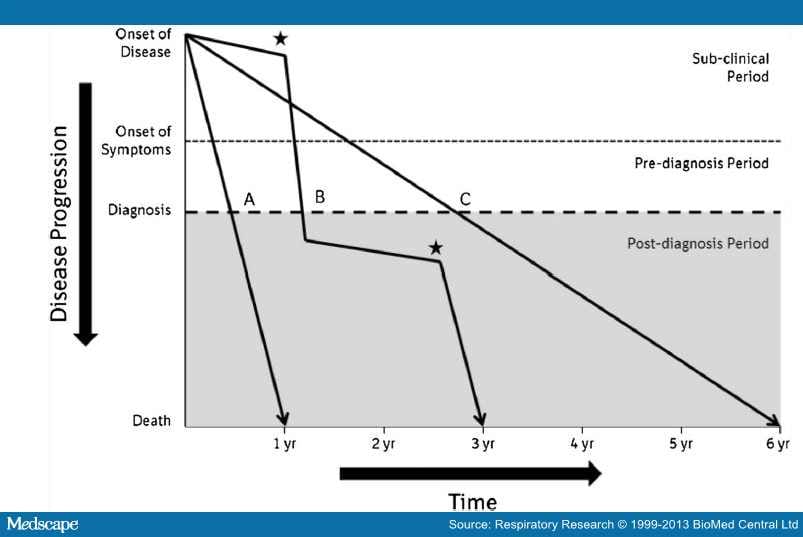
IPF has a median survival of 2-4 years from diagnosis. Most patients die within 3-5 years but some patients live much longer. See a simplified diagram of ways IPF typically progresses.

IPF - TREATMENT

Until pirfenidone (Esbriet®)) no effective treatment existed for IPF. In clinical trials Esbriet® was shown to decrease scarring (fibrosis formation) and the incidence of death from all causes and from IPF alone. See below for more details.

Cost: Esbriet® was funded in the UK and elsewhere before in Canada but it now is, In Canada Esbriet® costs provincial governments ~$43,000 CDN per patient per year.

DILEMMA
Esbriet® gives IPF patients hope for a longer life but, to some, that comes at an incredible cost to quality of life due to side effects.

The good stuff 
Although not a cure, Esbriet® offers the hope of maintaining lung function as measured by FVC (forced vital capacity - how much air a person can exhale during a forced breath). In IPF, FVC is a key measure of disease progression. Esbriet® doesn't improve FCV but does slow its decline.

Esbriet® has also has been shown to offer patients better life expectancy. For example, after one year:
  • 3.5% of patients on Esbriet® (n=22 of 278) died from all causes, versus 6.7% on placebo (n=42 of 277), a reduction of ~48%. 
  • 1.1% (7 of 278) died from IPF related causes versus 3.5% (22 of 277), a reduction of ~68%.
Of course, given the type of IPF disease a patient has makes such statistics iffy at best. No one knows how an individual's IPF will progress.

The bad stuff 
Unfortunately, Esbriet® has many side effects, also known as adverse events/reactions. It's important to recall that all drugs have side effects, ranging from harmless to severe reactions that require drug cessation.  

Also, with any drug's side effects, an individual may experience none, some, or all. A given side effect may show up immediately or only after being on the drug for awhile. Plus some side effects occur more commonly, others are rare. 

A complicating factor with side effects is that identifying them as directly related to the implicated drug can be difficult. The side effect may be due to drug interactions, a symptom of a co-existing disease, etc. 

Identification is easier if a side effect is well documented as commonly occurring and stops when the drug is stopped, even temporarily. This applies to sun sensitivity and Esbriet® (see below).
Adverse events related to Esbriet® include:
  • abdominal pain
  • bloating
  • gas
  • nausea
  • constipation
  • diarrhea
  • vomiting
  • decreased appetite
  • taste changes
  • difficulty sleeping
  • hot flushes
  • headache
  • indigestion, heartburn, or acid reflux
  • itchy, dry, or red skin
  • sun sensitivity (e.g., sunburn, skin rash, blistering or peeling skin)
  • sweating
  • tiredness
  • weight loss
  • muscle or joint aches or pains
  • Cough or hoarseness
  • sore throat
  • sneezing
  • ear congestion
  • dizziness
From my spouse's experience: 
  • Suppose you cannot get proper sleep, night after night (insomnia), so you always wake up tired.
  • Even when sleeping reasonably well, you're exhausted during the day.
  • You have no appetite and what you eat tastes different (awful).
  • You lose ~5 lbs every 10-14 days because you must force yourself to eat.
  • After eating anything, you're always bloated, have a stomach pain, suffer indigestion, and feel nauseous, often gagging during meals. 
  • After eating (and taking Esbriet®), you feel dizzy for a short time.
  • You alternate between diarrhea and constipation, the latter sometimes requiring extreme measures.
  • Your throat is always sore and you think you're coming down with a cold but it doesn't happen. 
  • You spend 1 hour in the sun and develop a sunburn and measles-like rash on exposed skin which lasts for weeks and requires stopping Esbriet® for a month, then going back on in increasing doses until the optimum dosage is reached.
    • The rash also means in future wearing long sleeves and a wide-brimmed hat (even in summer with temperature 30oC+) and lathering exposed skin with 50+ SPF lotion to walk outside and enjoy a sunny day.
  • You regularly suffer severe headaches. 
With these side effects eventually life becomes miserable. Do you 
  • Stay on Esbriet® because it extends your life?
  • Stop taking Esbriet® and opt for a better of quality of life though it may be shorter than if on the drug?
DOCTOR INPUT
In general, respirologists/pulmonologists review lung function tests, and, if they see lab measures like FCV haven't decreased, assume you will stay on the drug because it's helping. Indeed, they want you to stay on the drug, because opting for life is paramount in their world.

Severe side effects seem to mean almost nil to physicians, presumably because they've never experienced such hell. Also, as physicians, naturally they want to believe they can do some good, even if a disease is devastating and incurable. 

What doesn't happen is discussing the options and consequences (albeit uncertain), i.e., the reality of an incurable disease and what patients can expect, albeit based on population studies, which may or may nor apply to individual patients.

Often well meaning physicians assumes patients and their families want only hope and cannot deal with grim realities. Best to ignore them? 

To be fair, I'm unsure what physicians could say, given the uncertainties. As well, they know that some patients may grab onto something they say and it could come back to bite them. And some doctors may not want to unduly influence patients one way or the other. Mind you, in other circumstances, I've found that's often not true. And so it goes....

But physician reluctance to discuss realities gives patients precious little upon which to base life and death decisions, even if definitive outcomes  are unknown. Fortunately, I'm okay with reading the medical literature and research findings, but suspect many are not. 

Perhaps that's how it must be. As in life, after all is said and done, individuals are responsible for their own choices. But it would be nice to make informed choices based on a physician's knowledge and experience of your circumstances combined with what population studies show. 

BOTTOM LINE
How can patients with incurable diseases choose the best treatment option, even when one doesn't exist?  In our case, my spouse went off Esbriet®  for a month due to sun sensitivity adverse event (mandated by physician), then again later, due to other side effects that led to an unbearable quality of life. While off the drug, the symptoms lessened and many disappeared altogether.

He's back on Esbriet® now, opting for extending life and coping with drug's side effects. We'll see how it goes. Sadly, we have no real support nor wise advice when making decisions. We could join a support group and may do that in time. 

In closing, let me emphasize that there are far worse fates than developing IPF later in life. Overall, both I and my spouse feel pretty darn lucky, even with the latest side effects being a 'bummer', as we'd say in the 60s. Life is good, all things considered.

As always, comments are most welcome. Be aware that comments are moderated, but only to prevent spam.

FURTHER READING
Idiopathic pulmonary fibrosis: now a treatable disease and other highlights from the 2014 American Thoracic Society Annual Conference. CMAJ, May 27, 2014. 

Brett Ley B, Harold R. Collard HR, and Talmadge E. King, Jr TE. Clinical course and prediction of survival in idiopathic pulmonary fibrosis. Am J Respir Crit Care Med 2011;183( 4): 431-40.

King TE Jr, et al. A phase 3 trial of pirfenidone in patients with idiopathic pulmonary fibrosis. N Engl J Med. 2014 May 29;370(22):2083-92. Epub 2014 May 18.

My earlier blogs on IPF

Sunday, December 28, 2014

Sweet Dreams (Musings on funding of Esbriet for IPF)

Updated: 18 Feb. 2015

This blog is a follow-up to Good vibrations (Musings on new research on idiopathic pulmonary fibrosis) - initially posted 1 Sept. 2014  and updated 27 Dec. 2014 - in which I discussed how physicians vary in their approaches to patients with idiopathic pulmonary fibrosis (IPF) and the drug pirfenidone (EsbrietTM).
The blog's title derives from one of the Eurythmics' biggest hits, often sung by Annie Lennox on her solo tours.

To our surprise in early Dec. 2014 we were notified by a representative of the company that makes Esbriet (Intermune/Roche) that Peter had been funded by Alberta's Short Term Exceptional Drug Therapy (STEDT) program to receive Esbriet.

NOTE: We were not notified by a physician but by the manufacturer's rep, an RN. She told us the drug would be available at 3 locations, one of which was the UAH Rexall pharmacy, about 2 blocks from us. She gave us their phone number so that we could confirm when the  Esbriet could be picked up. Maybe it was because the physician that got the funding is no longer Peter's respirologist, since he moved to a nearby city and we got a new doc.

BACKGROUND
Much earlier our first respirologist had applied to STEDT on Peter's behalf. But Alberta's then Minister of Health, Fred Horne, indicated to forget STEDT unless CDEC OR Canada's provinces negotiated what they deemed a reasonable cost for Esbriet. That made us cynical of ever getting Esbriet. But it turns out there was hope.

QUANDARY
So now we are delighted to have STEDT funding for Esbriet for about 8 months with these provisos:
  1. DOC #1: The physician with Esbriet experience is no longer Peter's respirologist. 
  2. DOC #2: The new respirologist has no experience with it  - few physicians do, given its cost - and will be on leave beginning in the next few months. 
  3. SIDE EFFECTS: So far, there are none that warrant stopping the drug. Nausea, dizziness, and extreme fatigue occur but Peter's okay with them so far. 
  4. LAB TESTS: The Esbriet RN also told us to get baseline laboratory results for ALT, AST, and bilirubin monthly for 6 months, then quarterly, since Esbriet may affect the liver. Our family doctor kindly wrote a standing lab request. 
DOCTOR vs MANUFACTURER'S REP
About Esbriet's significant side effects, in the absence of physician involvement, the manufacturer's representative helped. Suspect this is because the manufacturer doesn't want patients to discontinue the drug because of adverse side effects. She gave advice on how to minimize a key side effect, gastrointestinal issues. For example:
  • Take pills ~5 hrs apart since Esbriet's half-life is 2 1/2 hrs. 
  • Increase dosage slowly and cut back if side effects are onerous.
  • She said she'd check with us later about adverse effects. And we can always call the toll free number for help at any time.
BOTTOM LINES
I admit we're an outlier, having changed physicians. But even if we still had the initial respirologist who applied for Esbriet funding under STEDT, would the situation be similar? Who knows?

It makes sense that manufacturer's representatives want to ensure Esbriet helps patients and is not discontinued due to side effects.

Alberta's healthcare system is wonderful in many ways and staffed with dedicated health professionals. But I also know from helping many seniors that to claim AHS is patient-centred is not a reality. 

Care is more cost-centred because it has to be, given the Alberta government's choice of priorities and taxation policies, e.g., tax breaks to oil companies, a flat tax that favours the wealthy, and no sales tax like other Canadian provinces. All more acute now that oil prices have tanked.

Sometimes doctor visits are similar to a factory assembly line. After 'x' minutes, you're given a clue to exit. Some docs specify you can discuss only 'x" issues. While I understand where they're coming from, and dig they need to earn a living and pay for their office's overhead, it's hardly patient-centred care. 

I look forward to learning how Peter's new respirologist manages his care using Esbriet on what will be his final journey. To be continued...
FOR FUN
Love this song and in some ways it resonates with this blog's theme.
  • Sweet Dreams (Are Made of This) by Annie Lennox, Live 8, Hyde Park, London, 2005 
As always, comments are most welcome. 

Monday, September 01, 2014

Good vibrations (Musings on new research on idiopathic pulmonary fibrosis)

Updated: 27 Dec. 2014 
AND THE BEAT GOES ON
This new blog is to relate what I discovered
  1. When generous friends wrote Alberta's then Health Minister, Fred Horne asking for Esbriet to be funded for idiopathic pulmonary fibrosis (IPF), including Minister Horne's response when I contacted him directly. 
  2. Interesting tidbits from additional medical research on IPF.
  3. How physicians vary in their approach to patients with IPF.
*** Plus - and it's a huge plus - a surprising update in early December (see blog's new ending). 

BACKGROUND
In 2013 my spouse was diagnosed with IPF, a deadly disease with no known cure and a median life expectancy after diagnosis of ~3 years.

Besides the diagnosis, it was a shock to learn that the one known treatment at the time (pirfenidone / Esbriet) was approved for use by Health Canada, but not funded by provincial governments.

I subsequently read many scientific papers on the issue and wrote 4 blogs that examined what it's like to get an IPF diagnosis and why Esbriet is covered by public funding in the UK but not Canada. In brief, reasons include
  • The Canadian Drug Expert Committee (CDEC), under the auspices of CADTH, decided that Canada should not fund Esbriet (18 April, 2013). 
  • The clinical trial results at the time were equivocal and CDEC opted for seeing the glass half empty, no doubt partly because Esbriet is expensive ($40,000 - $50,000/yr). Provinces would prefer not to pay for a drug that slows, but does not cure IPF, a disease affecting mainly the elderly.
  • To access the 4 earlier blogs on IPF: 'While my guitar gently weeps' (Musings on idiopathic pulmonary fibrosis).
Although we are fortunate to have great health insurance, it did not cover a drug as expensive as Esbriet. We understand why our drug maximum is $2000/yr, otherwise the plan would be unsustainable.

HOW GOVERNMENT RESPONDS 
Many friends kindly wrote the Alberta government, usually the Health Minister, Premier, or their MLA, using a variation of the Canadian Pulmonary Fibrosis Foundations' provincial advocacy packages. Regardless of how personalized they made their appeals - including that they knew the UK but not Canada funded Esbriet - in return all, including me, received what amounted to a government form letter, which totally ignored the content of our letters.

In return I wrote Minister Horne and asked him to cut the crap and reply to 3 simple questions.

To his credit, Fred Horne replied to my direct questions. If I interpret Minister Horne's reply correctly:
  1. Unless CDEC recommends Esbriet funding, Alberta won't fund it.
  2. Alberta's expert committee (ECDET) accepts (rubber stamps) CDEC's decisions.
  3. Forget about Alberta's Short Term Exceptional Drug Therapy (STEDT), unless a drug is approved for public funding by CDEC OR Canada's provinces negotiate what they deem a reasonable cost for Esbriet.
Alberta Health's replies were as expected. I just wish the government would be more transparent and upfront, instead of giving citizens the hope that maybe you can get your expensive drug, with unknown or iffy efficacy, under special funding. 

Maybe you can, but only if you are a cute child with a rare disease or if your disease is more common (e,g., cancer), thereby involving more voters. Cynicism or reality? You judge. 

WHAT RESEARCH SAYS
Since I wrote the prior blogs, new research has emerged on Esbriet's value in treating IPF, notably,
Accordingly, CADTH is looking at another submission on pirfenidone (Esbriet) and seeks input. 

In the meantime, Esbriet's maker, Intermune was bought by Big Pharma's Roche for $8.3 billion, likely in the hope that the U.S. FDA will approve Esbriet for use in the USA. Effects of the takeover on Esbriet's public funding in Canada remain to be seen.

A TALE OF TWO PHYSICIANS 
My spouse's initial lung specialist (pulmonologist / respirologist) is a physician with much experience, who gave Peter hope that he could get funding for Esbriet, which might significantly help, although not cure, his IPF. The doc patiently spent much time explaining IPF and its possible clinical courses.

He put us in touch with Esbriet's maker to investigate if our insurance would pay. He submitted Peter's name to Alberta's Short Term Exceptional Drug Therapy program (STEDT).

But he soon moved his practice outside our city to what is often called a 'bedroom community'. Although relatively close, driving is a challenge and I could not see travelling there for continuing care. 

Unfortunately, we quickly learned that Esbriet funding was a no-go (as explained above in correspondence with Fred Horne). The original respirologist was hopeful that it would eventually be funded, especially if enough people drew the Minister's attention to the issue of IPF and Esbriet / pirfenidone. Thus, we asked friends to write the Health Minister.

In a pulmonary care exercise program with an Edmonton primary care network, we were told that IPF could deteriorate quickly at any time (acute exacerbation), and we needed a physician to manage it. We opted for a respirologist who was younger and therefore the wait time to see her was less and was affiliated with the University of Alberta Hospital, the facility closest to us.

Her approach was caring but more or less 'all business' and straight forward.
  • She reassured Peter not to worry about no Esbriet funding. The drug is not a cure for IPF and has significant side effects. 
  • Her approach was, Let's take a few key tests (lung function, echocardiogram, CT scan, 6 minute walking test, review earlier sleep apnea test results) so that she could assess his current medical condition. 
  • Then she would discuss where he was at and treatment options.
We appreciated this approach: Let's assess the current state of the disease. What can we do, if anything?

LEARNING POINTS
Some of the key things we've learned:

1. Public advocacy programs for government funding of expensive drugs to treat incurable diseases are worthwhile but work better under certain circumstances.
  • Many voters are mobilized to advocate the cause. 
  • Helps, but does not guarantee success, if
    • Celebrities participate
    • Disease is common
    • Victims pull at heart strings 
2. Government funding of drugs is shrouded in smoke and mirrors. 
  • Health Canada approval does not equal provincial funding.
  • Governments seem content to let advocates 'piss in the wind' and only fess up to reality when pressed.
  • Provincial exceptional drug therapy programs to fund high cost drugs for rare conditions do not apply to drugs unapproved for funding by CADTH's CDEC. [Except perhaps for children with heart-wrenching diseases like this little girl.]
3. Lung specialists vary in their approaches to dealing with patients with life-threatening, incurable diseases.
  • One approach does not fit all because communication involves a communicator (Dr.) and a recipient (patient), and recipients vary greatly in their ability to accept harsh facts. 
  • In our case a reality-based approach is okay. 
4. Evidence-based medicine is highly touted and used to denigrate or justify many treatments. But often the evidence is not there or is conflicting or flawed or tainted by private interest and politics. 
  • Canada's CDEC clearly puts cost-effectiveness first. No doubt cash-strapped provinces prefer this. 
  • Otherwise, why would the UK's NICE committee recommend funding Esbriet to treat IPF, and Canada's CDEC recommend the opposite, based on the same evidence? 
    • For the record, NICE's 64-page report is transparent and discusses all issues in detail. CDEC's report is 5 pages. 
    • UK experts noted that it was unlikely that clinical trials for IPF treatments can ever have enough statistical power to detect a difference in mortality. They recognized this limitation.
      • Yet new studies show Esbriet reduced the relative risk of death or disease progression by 43% compared with placebo.
    • Canada's experts chose to ignore statistical power.
      • Statistical power: Ability of a study to detect a real difference, if one exists. Power is affected by how big the difference is and sample size. If a difference is big, it's easier to detect. And large sample sizes make a real difference easier to detect. 
5. Autopsies show that IPF coexists with many serious conditions, making diagnosis and treatment options difficult. As an example, 
  • In discussing why spouse's lung biopsy showed evidence of pulmonary hemorrhage, not one specialist could explain it. 
  • Seems medicine remains both a science and an art. 
UPDATE
Miracle of miracles, early in Dec. 2014 we learned that the Alberta government would fund Esbriet under the STEDT program. For this we thank Peter's initial respirologist, Dr. Lyle Melenka. See
FOR FUN
As Peter and I deal with a diagnosis of an incurable disease, idiopathic pulmonary fibrosis, we focus on the glass half full. Every day, every month, every year is a blessing.

Which brings me to an old but fabulous Beach Boys ditty.
Further Reading
As always, comment are welcome.

Saturday, November 09, 2013

Sweet dreams or maybe not (Musings on idiopathic pulmonary fibrosis)

This is the first of a series of many personal blogs on a rare deadly disease, idiopathic pulmonary fibrosis (IPF), and its only known effective treatment, pirfenidone (Esbriet).
It's a tale of well intentioned promises, deceit, ageism, convenient government decisions, and arbitrary recommendations by health experts.
And as we know, the cliche is correct: The road to hell is paved with good intentions.
The blog's title comes from a favorite Annie Lennox song. It fits because we had retired and looked forward to 'sweet dreams', a relaxed life of doing what we loved: writing and drawing for Peter and part-time work in  transfusion medicine for me, as well as travelling the globe as the mood struck us. That was the sweet dream.

Edmonton writer Todd Babiak co-founded a company called Story Engine. Its premise & first step: 
  • People are born to understand story.
  • The first step in the Story Engine process is to seek your truth, the components of your story: your past and present, the way others see you and the way you see yourselves.
If you don't have IPF, why should you read the blog? Not in my back yard (NIMBY), you say? It's not my story, you say?

Well, you or someone you know may get IPF one day.The disease and its treatment reveal much about our Canadian health care system. The struggle to be treated presents dilemmas:
  • How to best advocate for patients who are refused treatment by an arbitrary decision of a so-called 'expert panel' when similar panels in other countries recommend the opposite.
  • Whether or not to call upon friends to serve as advocates.
  • How to influence a provincial government, in this case Alberta Health, its Minister of Health, Fred Horne and Premier Alison Redford, when their decision may depend upon other provinces doing the same.
So, here's the start of our story about idiopathic pulmonary fibrosis.... 

BACKGROUND
This year we got a real shock. My spouse Peter was diagnosed with interstitial lung disease, aka pulmonary fibrosis. He had gone to his family physician because of extreme shortness of breath and fatigue with routine activities, a dry cough, and unexplained weight loss.

An ECG suggested possible heart disease. An X-ray suggested possible pulmonary fibrosis. Apparently, indications for pulmonary fibrosis were present on an x-ray 4 years earlier but now the fibrosis was more pronounced.

The docs decided to do an angiogram to identify to what extent, if any, coronary artery disease contributed to symptoms. Turns out not much. He had coronary heart disease but no blockages that warranted angioplasty and a stent. The surgeon joked that many people at Peter's age had similar blockages, they just didn't know it. 

The heart specialist told us that future investigation was in the hands of a lung specialist, aka pulmonologist, because the enhanced CT scan confirmed interstitial lung disease. 

The family physician then referred Peter to a pulmonologist, who prescribed multiple laboratory tests to rule out possible causes, as well as lung function tests to determine the extent of the lung damage.


Most importantly, he said Peter needed a lung biopsy to diagnose the type of interstitial lung disease and related cause before treatment could be determined. Turns out interstitial pulmonary disease, like ice cream, comes in multiple flavours. 

We'd never heard of the damn disease.But it apparently affects ~30,000 Canadians, with a projected 5,000 deaths each year.

ESBRIET
At the same time the lung doc gave us a brochure on idiopathic pulmonary fibrosis (IPF), the type with the worst prognosis and with no known effective treatment until 2012 when a drug called pirfenidone (Esbriet) was licensed by Health Canada. 


The doc also explained that Esbriet costs between $40,000 to $50,000 CDN per year, making it impossible to access except for the rich or being insured by insurance companies who will pay for it. Yikes! Cost is a fatal flaw....

In retrospect, we know why the lung doc mentioned IPF before it had been definitively diagnosed. It's the most common type of interstitial lung disease  and also fits with Peter's age group (senior citizen). 


IPF
In the meantime we scoured the Internet about interstitial lung disease, especially idiopathic pulmonary fibrosis. We learned that the idiopathic type is associated with gastro–esophageal reflux disease (GERD) and a history of smoking. Turns out Peter has GERD and smoked in his youth but stopped a whopping 28 years ago. It's important to note that associations do not equal causation. 


As expected, the lung biopsy showed Peter had idiopathic pulmonary fibrosis (IPF), idiopathic meaning cause unknown. 


The downside of IPF is that the life expectancy is 2-5 years from time of diagnosis, although some patients live longer, with what quality of life is unclear. IPF is characterized by excessive scarring in which fibrous tissue make the lungs rigid, and ultimately resemble a honeycomb. 


'SO WHAT'? MESSAGE

So... at this stage of the story Peter has IPF, we're told a drug called pirfenidone (Esbriet) can help, but its cost puts it beyond our grasp. What to do?

The lung doc said he'd fax the drug company's representative, who would contact us to discuss options.

We dig why the lung doc held out the hope of Esbriet. He had good intentions and wanted to give us hope. Must be tough to be a physician who tells patients they have a fatal disease and there's nil we can do. 


Is giving them false hope the way to go? Don't know but gut reaction is we prefer reality.

So....we wait for the call from the drug company and it comes. See next blog.

For fun:

  • Sweet Dreams by Annie Lennox (Live 8 concerts to 'Make Poverty History', this one in London, 2005)