Updated: 22 June 2018 (Fixed links, increased clarity)
Decided to expand on my journey into Buddhism to help readers understand where I'm coming from with regard to my husband's IPF and Esbriet. First, Buddhism may not even be a religion as it doesn't propose, as most traditional religions do (Christianity, Judaism, Islam), that there is a supreme, all knowing being who created us, our earth, indeed the entire the universe.
BACKGROUND
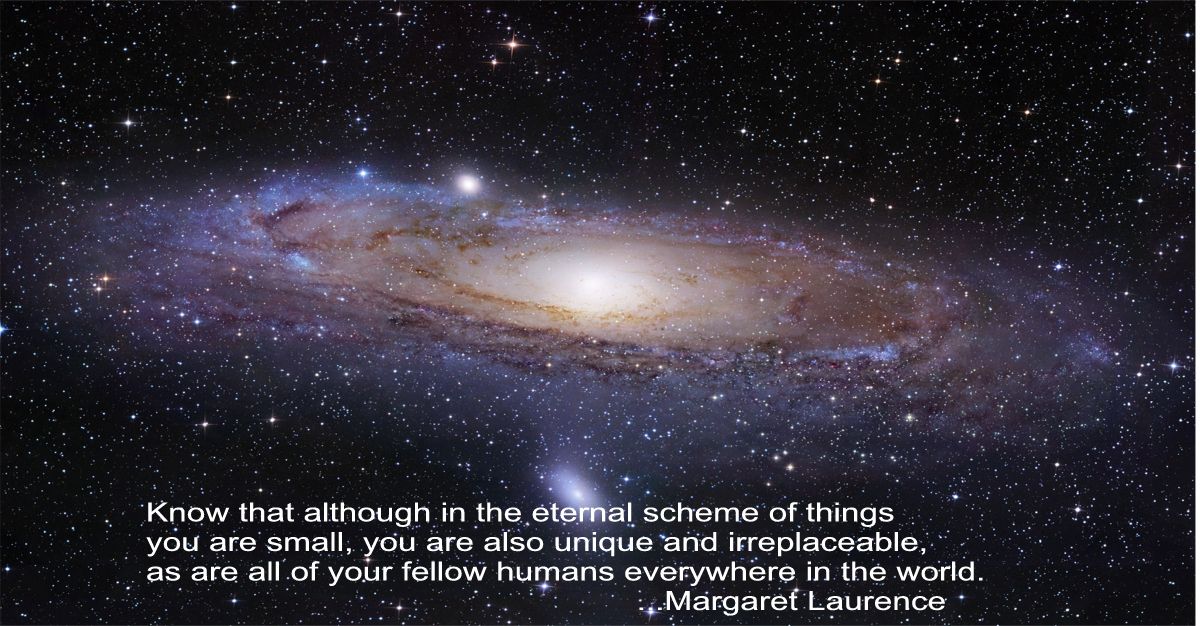
Think about the universe. We don't know where it ends and it may go on forever. Today's astronomy experts estimate the total stellar population at roughly 70 billion trillion.
One of which is Earth, the pale blue dot as Carl Sagan called it.Traditional religions ask us to believe that we are special, the creatures that know and know we know. That's true but evolution clearly shows that we're just one branch of life on earth that began of millions of years ago. Canada's Margaret Laurence balanced the two truths well:
Yes, I believe in Dawkins' The God Delusion. And The Greatest Show on Earth is awesome, a word I seldom use.
FACT: When you examine human DNA and those of other living creatures (not just primates ~gorillas, chimps), you see that all life is related, we're all distant cousins, not just with apes, birds, cows, pigs, fish, whales, but even with the vegetable kingdom of trees, plants,etc. Evolution is not a straight line but consists of branches that led to different life forms.
Despite the great diversity of life, we are connected with all other life forms. Yes, I believe I'm distantly related over millions of years to the veggies I eat. Occasionally I mutter, 'Sorry, little buddy' when eating a pea or carrot.

BUDDHISM
So, where does Buddhism fit and why does it resonate with me and help in coming to grips with a fatal disease in a loved one? What follows is my lay person's take on Buddhism. My views are based mainly on three books:
- Buddhism: A Concise Introduction
- Living in the Light of Death: On the Art of Being Truly Alive
- Buddhist approach to facing the inevitable facts of growing older, getting sick, and dying.
- Coming to Our Senses: Healing Ourselves and the World Through Mindfulness by Jon Kabat-Zinn (scroll to his profile)
Usually called the '4 noble truths', these ideas are what spoke to me from the get-go. How I see them (my words):
1. Life consists of suffering;
2. We suffer because we overly cling to our desires and possessions and become sad when we lose them. We see life as being 'all about me' and our needs;
3. We can end life's suffering if we see its true cause;
4. The way to end suffering is to follow the ''Eightfold Path'.
How to end suffering
Please remember that the Buddha (Siddhartha Gautama) lived in India between the sixth and fourth centuries BCE. Like traditional religions, many myths and legends and lack of reliable history, make it impossible to know if he existed and who the heck he was (See Further Reading - Ancient History Encyclopedia).
Buddhism grew out of a reaction to Hinduism, similar to how Protestantism was a reaction against Roman Catholicism. As such Buddhism includes reincarnation and karma, but western Buddhists like me are free to reject reincarnation. Karma is what my spouse often says:
- What goes around comes around.
- Always take the high road.
1. Right Views - Believe that the cause of human suffering is because we strongly cling to our needs, often basing our happiness on our possessions and the actions of others towards us. Believe in all the 4 Noble Truths.
2. Right Intent - Do we really want to deal with the issue of what causes suffering? Are we prepared to be single-minded and persistent?
3. Right Speech - Become aware of what our speech says about our character and identify the motives that lead to being unkind. Strive to become more truthful and charitable to others.
4. Right Action - Understand why we act as we do, and try to behave better, e.g., don't lie, steal, kill (more or less Christianity's 10 commandments).
5. Right Livelihood - A man of his times, Sid included slave trader, prostitute, arms maker, and occupations like butcher as ones not to become. Reminds me of my Dad's view of used car salesmen, which caused me to go into helping professions, first high school teacher, then medical laboratory technologist, transfusion educator, and finally consultant and webmaster/mailing list manager.
6. Right Effort - It's hard to follow the main precepts of Buddhism (being a better person) and takes much effort. I see it as a journey, not a destination, because I fail daily but still strive.
7. Right Mindfulness - Being intentionally aware of our thoughts and actions in the present moment, non-judgmentally.
8. Right Concentration - Concentrate when meditating, focus the mind. Goes together with 'right mindfulness'. The two taken together become the practice of meditation.
OTHER BUDDHIST CONCEPTS
Four more key Buddhist concepts that resonate with me:
1. Impermanence. Everything in life is impermanent. Our bodies decay, relationships change, even mountains erode. Change defines life. Don't cling to possessions, loved ones, a cozy existence. Don't depend on others for happiness.
We will eventually die. Indeed, ultimately, we will all lose everything we hold dear. And it's normal. Put another way, 'Get over yourself.'
2. Loving kindness. Before we can love and help others we must love ourselves, be kind to ourselves. Only once we love and accept ourselves for who we are, our strengths and weaknesses, can we truly give ourselves to others.
3. Dont-know mind, sometimes called a beginner’s mind, is wide open, not closed. What I love about Buddhism is that it's open to questioning. In brief, if something sounds like BS, subject it to evidence and reject it if it doesn't meet the test.
4. There is no self. This is tough concept to understand. When we say my body, my needs, who the heck is speaking? Is there a person inside our head that is "I"? If so, who is this 'being' and is it separate from our bodies? Does what traditional religions think of as an everlasting soul separate from our body exist? Buddhism says No.
SUMMARY
Born into a Western culture and trained in the scientific method, there are parts of Buddhism I reject. Rather I see myself as believing in core, original Buddhist teachings, i.e., concepts that are generally accepted as true by all the branches that arose as Buddhism spread in Asia and beyond, e.g., Mahayana Buddhism and Theravada Buddhism each with various sects. Certainly, I reject reincarnation and the transmogrification of Buddha into a near god-like creature, with bejewelled statues in monasteries.
And I don't get hung up on the words in Pali, the language of Theravada Buddhism, words such as anicca (suffering), dukkha (suffering), et al.
Bottom line: What does Buddhism mean to me? To end life's suffering, see its cause as being 'all about me'. Focus on why we behave poorly and try to be a better person by following the eight paths to end our suffering and become happier. Simply put, live in the present, lead a moral life, and use mindfulness meditation (2 min. video) as a tool to reduce stress and improve wellbeing.
Humans have evolved as life forms who know and know that we know. Buddhism proposes that we are all in this world together, that all living things are part of the same family of life on Earth.
So there you have it. My take on Buddhism, why I value it and how it helps me cope.
FURTHER READING
Buddhism, an introduction (PBS)
5 minute introduction to Buddhism
Siddhartha Gautama (Ancient History Encyclopedia)


