A friend recently asked why I left Facebook (FB). Many have written about their FB dilemma, and why they leave, join, leave, join. Several things bother me about FB - here's a few:
1. Privacy: Ongoing privacy issues with its app developers (they get your info then can sell it to others). FB keeps backing off when caught but the young geeks in charge really do not get the privacy issue and I do not trust them.
2. Advert magnet: FB's core business is to create communities to whom advertising can be targetted. It can do this since FB knows a great deal about its users. I'm against this insidious practice in principle.
Truest quote I've heard about FB was on CBC radio awhile ago. About free social media sites like FB, a social media expert said , "If it's free, what they are selling is YOU."
3. Quasi-voyerism: FB is supposed to be a social medium, but, like mailing lists, most people lurk and make few, if any, posts. No communication, no interaction, just a kind of harmless 'voyeurism', presumably getting pleasure from glimpsing the lives of others. The volume of genuine personal interaction among the 'friends' compared to deadening silence (or total drivel) is low.
4. Friends - really? Once on FB, you get many friend requests from people who in no way are your friends. Indeed, some barely know you and some you may not have even gotten along with that well. It's hard to refuse a 'friend' request because you know the person will not understand, may be hurt, and just wants to touch base with a colleague or acquaintance.
Yet it's ridiculous to give virtual strangers access to your daily activities, thoughts, and feelings, assuming you use FB as a true social medium. I do not like dealing with this dilemma time and time again.
5. Posing: FB lends itself to posing and posers. Naturally, all users tend to reveal the parts of themselves they want others to see, i.e., their admirable selves, their bragging points, etc. FB is somewhat akin to those Christmas cards with long updates that some people send in which their kids are practically Nobel prize winners and they are happily planning their annual family get together in the hills of Tuscany. It's all harmless, but the hypocrisy tends to get to me.
6. Time waster: FB can easily become a huge time waster as you scroll through the drivel to get to the gems. Since our time on earth is finite, time on FB must be assessed against other activities. In most (not all) cases, FB loses. To me, few, if any, important things in life happen in front of a computer screen.
That said, now that I've left, I truly miss interacting on FB with my friends. The choice to opt out of FB was not an easy one. Most people just go with the prevailing flow (500 million users and growing), but I've never been good at that. I often think of returning but have resisted so far.
Currently, I'm trying a new experiment with twitter. Follow me here: http://twitter.com/bogeywheels
Monday, January 24, 2011
Sunday, December 26, 2010
Why is everything always "under investigation"?
The holiday season seemed like a good time to get a trivial language matter that has bugged me for awhile off my chest.
Have you noticed how when the police (or any group) investigate a possible crime or issue, the media invariably report that the matter is "under investigation"? Why do they never say that something is being investigated?
Using a similar grammatical construct, some examples of why "under investigation" and similar are a poor use of language:
Or maybe I should write, "Journalism schools should put the benefits of forceful language under promotion."
It's up to you, the readers, to put the issue under decision... oops...make that "to decide".
Have you noticed how when the police (or any group) investigate a possible crime or issue, the media invariably report that the matter is "under investigation"? Why do they never say that something is being investigated?
Using a similar grammatical construct, some examples of why "under investigation" and similar are a poor use of language:
- "Whether Canadians prefer hockey to football on Monday was under discussion at the conference." vs "Whether Canadians prefer hockey to football was discussed at the conference."
- "The hospital's new computer system is under implementation in January." vs "The hospital's new computer system is being implemented in January."
- "Our massive transfusion policy is under review." vs "Our massive transfusion policy is being reviewed." vs "We are reviewing our massive transfusion policy."
- "Our dinner was under consumption when the cops arrived. " vs "Our dinner was being eaten when the cops arrived." vs "We were eating dinner when the cops arrived."
- "My eyes were under examination by the optometrist." vs "My eyes were being examined by the optometrist." vs "The optometrist examined my eyes."
Or maybe I should write, "Journalism schools should put the benefits of forceful language under promotion."
It's up to you, the readers, to put the issue under decision... oops...make that "to decide".
Monday, September 27, 2010
When journalists praise 'bottom feeders'
Gary Lamphier's column of August 18, 2010 ('Cash Store rings in new phase of success') failed to elucidate how companies that charge high interest rates for short-term loans operate nor provide details of the legal troubles of Cash Store, which once operated as Rentcash and Instaloans.
Indeed, Lamphier's column reads as a promo for Cash Store. All he reveals about the business and its background is that
As well as profiling such businesses, details of the company's history of being sued would have provided readers with valuable insight. As but one example, in 2008 Rentcash settled an Ontario class action suit for $3 million.
The lawsuit alleged that brokerage fees, in combination with interest charged by The Cash Store and Instaloans on customer loans, constituted interest in excess of the maximum rate prescribed by the Criminal Code of Canada, which forbids charging interest rates of over 60% per year.
The fact that such services are legal, and that they serve a segment of the population, does not change the fact that cash-loan firms profit specifically from those in poverty. Among its services, Cash Store offers short-term cash advances for up to 50% of customers take-home pay and short-term loans against their Child Tax, Disability, Old Age Pension, and Employment Insurance. Clients are those who cannot exist from payday to payday, including the disabled and old age pensioners.
Cash Store says it provides full disclosure of fees, but a search of its websiteshows no information on interest rates and other charges. Cash Store may have altered its most exorbitant interest rates and fees, but it did so after being faced with lawsuits and changes in provincial regulations.
Readers may disagree on whether, at their core, such businesses are predatory and inherently unethical. To assess their services and record of behavior, we need information and context. Some say such companies provide a needed service. That could be said of drug dealers and loan sharks too. The only real difference is that payday loan companies are legal.
All Lamphier does is spread the word that Cash Store has become successful. Too often business reporters just keep score of who is winning and losing and gladly 'pimp' for the winners, even if they are 'bottom feeders' like Cash Store.
While it no doubt helps a reporter to be nice to those reported on, providing context would be appreciated. Otherwise, the public is surprised by events like the subprime mortgage crisis that led to a global banking meltdown while reporters were asleep at the switch. More analysis please and less cheer leading:
Indeed, Lamphier's column reads as a promo for Cash Store. All he reveals about the business and its background is that
- Some provinces have established clear interest rate caps for short-term loans
- Loan rollovers have ended, and several class-action lawsuits have resolved, all of which "have finally cleared the air for Cash Store's investors."
As well as profiling such businesses, details of the company's history of being sued would have provided readers with valuable insight. As but one example, in 2008 Rentcash settled an Ontario class action suit for $3 million.
The lawsuit alleged that brokerage fees, in combination with interest charged by The Cash Store and Instaloans on customer loans, constituted interest in excess of the maximum rate prescribed by the Criminal Code of Canada, which forbids charging interest rates of over 60% per year.
The fact that such services are legal, and that they serve a segment of the population, does not change the fact that cash-loan firms profit specifically from those in poverty. Among its services, Cash Store offers short-term cash advances for up to 50% of customers take-home pay and short-term loans against their Child Tax, Disability, Old Age Pension, and Employment Insurance. Clients are those who cannot exist from payday to payday, including the disabled and old age pensioners.
Cash Store says it provides full disclosure of fees, but a search of its website
Readers may disagree on whether, at their core, such businesses are predatory and inherently unethical. To assess their services and record of behavior, we need information and context. Some say such companies provide a needed service. That could be said of drug dealers and loan sharks too. The only real difference is that payday loan companies are legal.
All Lamphier does is spread the word that Cash Store has become successful. Too often business reporters just keep score of who is winning and losing and gladly 'pimp' for the winners, even if they are 'bottom feeders' like Cash Store.
While it no doubt helps a reporter to be nice to those reported on, providing context would be appreciated. Otherwise, the public is surprised by events like the subprime mortgage crisis that led to a global banking meltdown while reporters were asleep at the switch. More analysis please and less cheer leading:
- Most journalists failed to pick up the worldwide crunch that was to rock capitalism. Were they lazy, or embedded with the bankers? (British Journalism Review 2009 20(1):19-26.)
Saturday, August 07, 2010
Can we outsmart nature?
Canada's National Post has many columnists who deal in the realm of ideas. Despite often disagreeing with many of the NP's thought merchants, I read them all.
Today this column by George Jonas caught my eye:
* Controversy:
Today this column by George Jonas caught my eye:
- A strange way to promote understanding (George Jonas, National Post, 7 Aug. 2010)
* Controversy:
- New York votes for tolerance (Jerusalem Post)
- The case against the ground zero mosque (Forbes Magazine)
Jonas cites 'an old fable' as the reason why:
Versions of the 'Scorpion and the Sage' are commonly quoted by those into transcendental meditation. Differences in the various versions tend to be trivial but the endings can create significant nuances. For example, here are three other endings:A sage on the riverbank rescues a scorpion that has fallen into the water. When the sage pulls it out, the scorpion twists to sting him and falls back into the river. The sage rescues it again, and the same thing happens.
The sage is about to rescue the drowning arthropod for the third time, when a disciple stops him. "Master," he says, "teach me. Are you no wiser than the scorpion to keep making the same mistake over and over again?"
"A scorpion must sting because it's a scorpion," comes the reply. "I must save it, because I'm a sage. Nobody's wiser than his nature."
- "It is the scorpion's nature to sting, but it is my nature to save."
- "It is the scorpion's nature to sting, and it is my nature to be helpful to all beings. If the scorpion keeps its nature even in the face of death, why should I give up my compassionate nature in the face of his sting?"
- "My friend, just because it is the scorpion's nature to sting, that does not change my nature to save."
In the context of the fable, I interpret 'nature' to be one's essential characteristics, qualities, and core beliefs.
While each ending has something to recommend it, I prefer the one cited by Jonas:
- "A scorpion must sting because it's a scorpion," comes the reply. "I must save it, because I'm a sage. Nobody's wiser than his nature."
It's the last bit that gets me: "Nobody's wiser than his nature." Wiser interjects intellect, intelligence, and judgement into the equation.
Jonas seems to be saying that the we and they in the mosque issue, indeed all of us, are hard-wired to behave in a certain way (our nature). Even if objective analysis shows otherwise, all concerned will behave in accord with their natures.
Is this what he meant and is it true?
- We cannot change our nature and are prisoners to it.
- Our qualities* will always trump our intellectual findings. (*compassion and empathy vs. indifference and hatred)
- Our core beliefs (e.g., the weakest among us deserve respect and help, not disdain) overpower critical analysis.
- Emotions not only influence our thinking but rule our objective thoughts.
- Our hard-wired nature dominates our ability to reason.
Does "Nobody's wiser than his nature" seem a truism that holds for most, if not all, major decisions made in life? Are personal characteristics, emotions, core beliefs always paramount when we make important decisions, regardless of what our intellectual, objective assessment determines?
Something to think about....
Update: Testing America's tolerance (Rex Murphy, National Post, 14 Aug. 2010)
Monday, July 12, 2010
Canada's shame (Pimping asbestos overseas)
Updated: 15 Dec. 2016 (to fix one of the links)
- Health orgs call on governments to ban use and export of asbestos from Quebec mines (5 July 2010)
- Cancer Society deeply disappointed Quebec has approved loans to asbestos mine (29 June 2012)
Reminds me of people moaning about poor American tobacco farmers losing a living and how the US government subsidizes an industry that kills millions. Tobacco companies sell a deadly product to developing countries now that domestic markets have decreased.
Turns out Canada also plays this despicable game. Shame on us!
Friday, March 20, 2009
When journalists become apologists
Sometimes you read something in the paper that requires a response. This column on Alberta's oilsands qualified:
Yes, the war in Darfur is awful. And deadly. And ugly. And it creates a pressing humanitarian crisis that clearly must be addressed, from refugee camps to starvation.
We get it. We don't need the United Nations to tell us. But let's get a bit of perspective. Darfur has resulted in about 300,000 deaths. Accurate numbers of dead are difficult to estimate, partly because the government obstructs information gathering, but the death total doesn't even make the top 10.
Hey, WWII killed 6 million Jews to say nothing of 20 million citizens of the former USSR. The Khmer Rouge in Cambodia (1975-78) killed about 1.5 million, and the war in the Congo (1998-2003) resulted in 4.5 million deaths. Now, those are impressive numbers. You want a world-class humanitarian catastrophe? Sorry, you'll have to look far beyond Darfur.
Does that excuse the Sudanese government from its role in the disaster?* Of course not. But again, a wee bit of perspective.
Your oilsands column makes you just another PR flunky, an apologist whose role it is to whitewash and spin what's happening. The public deserves better.
Note: A shorter, edited version of this blog appeared as a letter to the editor (Edmonton Journal, Mar. 5, 2009): "Maybe not the worst but still bad"
- "Oilsands a poor excuse for world-class bogeyman" (Gary Lamphier, Edmonton Journal, Feb. 28, 2009)
Yes, the war in Darfur is awful. And deadly. And ugly. And it creates a pressing humanitarian crisis that clearly must be addressed, from refugee camps to starvation.
We get it. We don't need the United Nations to tell us. But let's get a bit of perspective. Darfur has resulted in about 300,000 deaths. Accurate numbers of dead are difficult to estimate, partly because the government obstructs information gathering, but the death total doesn't even make the top 10.
Hey, WWII killed 6 million Jews to say nothing of 20 million citizens of the former USSR. The Khmer Rouge in Cambodia (1975-78) killed about 1.5 million, and the war in the Congo (1998-2003) resulted in 4.5 million deaths. Now, those are impressive numbers. You want a world-class humanitarian catastrophe? Sorry, you'll have to look far beyond Darfur.
Does that excuse the Sudanese government from its role in the disaster?* Of course not. But again, a wee bit of perspective.
- *Since this blog was written, the International Criminal Court in The Hague has issued an arrest warrant for Sudan's President for war crimes and crimes against humanity.
Your oilsands column makes you just another PR flunky, an apologist whose role it is to whitewash and spin what's happening. The public deserves better.
Note: A shorter, edited version of this blog appeared as a letter to the editor (Edmonton Journal, Mar. 5, 2009): "Maybe not the worst but still bad"
Sunday, February 22, 2009
Alberta's dinosaur legacy
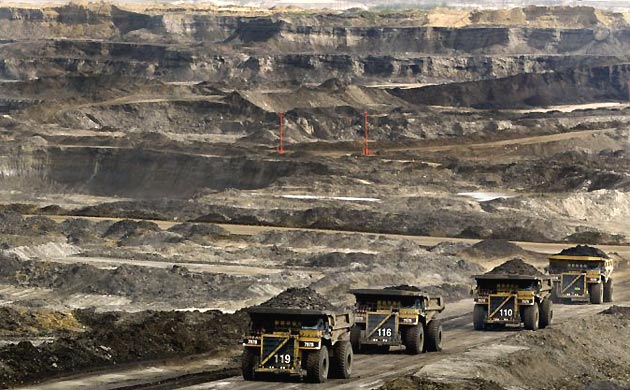
Why is the political right always so wrong? Latest example concerns Alberta's oil sands development. Have you ever seen the oil sands?
In truth, our Premier takes the opposite approach to Obama. Out of short term self interest, he and his colleagues emphasize one thing - spending public resources on how to make extracting oil from the tar sands cleaner instead of how to wean us off fossil fuels. They continually grovel to oil companies, thinking of new ways to give them tax breaks and incentives.
Just like their Republican counterparts, in Albertastan it's all "Drill, baby drill!"
That's like screaming,
The whole world suffers from such short sighted thinking. We need to take a broader approach and think of the
"Drill for typewriters" (Stafford "Doc" Williamson on American Chronicle) Making America stupid (Tom Freidman) Tide turns against Alberta's 'dirty' oil sands
- Take a look and weep
Alberta politicians like Premier Ed Stelmach brag that Obama is "speaking Alberta's language":
"Balancing the environment and the economy, investing in carbon capture and storage and technology. They're all things that Alberta has been talking about. That's good news for Alberta, good news for Canada and good news for all North Americans."Really? The difference that 'Steady Eddy' does not see is that Obama talks about taking a broad approach to energy and the environment. Obama stresses that no one strategy will work - an effort has to be made on many fronts - but the emphasis needs to be on weaning us off gas, oil, and coal and pushing for more sustainable and cleaner sources of energy. See
In truth, our Premier takes the opposite approach to Obama. Out of short term self interest, he and his colleagues emphasize one thing - spending public resources on how to make extracting oil from the tar sands cleaner instead of how to wean us off fossil fuels. They continually grovel to oil companies, thinking of new ways to give them tax breaks and incentives.
Just like their Republican counterparts, in Albertastan it's all "Drill, baby drill!"
That's like screaming,
- "Typewriters, baby, typewriters!" at the dawn of the computer age*
- "Carbon paper, carbon paper!" when photocopiers came out
The whole world suffers from such short sighted thinking. We need to take a broader approach and think of the
- Energy of the future (The Economist, June 2008)
- The best thing that rich-world governments can do is to encourage the alternatives by taxing carbon (even knowing that places like China and India will not) and removing subsidies that favour fossil fuels.
By clinging to fossil fuel, Alberta's dinosaur politicians are leaving us all a sad legacy.
Further reading
Friday, December 05, 2008
Canada's pygmy Prime Minister
Canada is in the midst of a political crisis:
Yet Harper had his Finance Minister toss these into an economic update, something that most observers, including supporters of the Conservative Party, now describe as his "bully" gene or arrogance. Harper's decision clearly triggered the current crisis. Instead of an economic plan to deal with a crisis our PM opted for partisan attacks.
The opposition parties were astounded and reacted as would be expected. Let him get away with this in a minority government and who knows where it would stop. The trigger was the partisan attack, especially on their finances, which could cripple them, but Harper also chose to ignore the economic crisis and paint an overly rosy picture of Canada's economy.
They proposed a 2-party coalition. Unlike Harper, the coalition pledged to deal realistically with the economic crisis.
That's how parliament works - the government must have the confidence of the House of Commons or it falls. Rather than calling another election so soon over the last, a coalition can take power under our system.
But such a coalition would also inflame the West, which had voted overwhelmingly for the Conservatives. Westerners could view the coalition as a way to cheat them of their government. An added problem is that it would be headed by Dion, an ineffective leader who had agreed to step down in May 2009 after the Liberals had a poor showing at the polls. And, perhaps most of all, changing governments during an economic crisis seemed risky.
To combat his imminent defeat, Harper backed down on the triggering partisan ploys but to no avail. The opposition had had enough and no longer trusted him.
Accordingly, Harper ratcheted up the rhetoric. He decided to demonize the Bloc as evil incarnate, vile separatists about to destroy Canada, even though he has a long history of cosying up to them himself when he needed their support. He said the Bloc was part of the coalition when it was not. He said the coalition leaders did not have a Canadian flag at their signing ceremony when two were there and easily visible. He plain lied.
This Harper tactic has stirred up latent Western alienation against Eastern Canada and Quebec in particular. His caucus was heard to sing "O Canada" during the crisis, which reminded me of McCain and Palin's right wing supporters chanting USA! USA! as if they had a monopoly on patriotism. Pardon me while I puke. Are we in for rallies where Conservative supporters chant "CA-NA-DA! CA-NA-DA!"?
Harper went to the Governor General and asked that Parliament be prorogued (suspended) until 26 Jan. 2009. This is the first time that a PM has ever suspended Parliament to avoid defeat. And in the midst of an economic crisis no less.
Here come the US-style attack ads.... They are guaranteed to be full of distortions and outright lies and name calling and he counts on us being stupid enough to believe them. Unfortunately, many voters can be swayed by such nonsense and a media blitz of attack ads. His support is up.
Is this what's coming next from our PM in a month-long string of advertisements aimed at keeping power? That the Conservatives alone love this country and want what's best for it? Are supporters of the Liberals and NDP to become "The Others," not quite "real Canadians" but left-leaning socialists, just one step away from "Commie red b_astards"? Is that where he is heading, all in an attempt to save his own skin? You know they are short of ideas and valid arguments when the separatist and socialist labels come out.
When Parliament resumes in January, who knows what will happen. The coalition is unlikely to hold given that the Liberals are in the midst of a leadership race. If Harper gets his way, the hate mongers within his ranks will be out in force. Canadians of different political persuasions will be turned against each other. His supporters will be so aroused against a coalition that they will destroy opposition signs, attack opposition MP offices, and spit on coalition supporters in the street, or worse, since they are anti-Canadian. All in support of his keeping power.
Most Canadians just want our political leaders to show leadership and cooperate so that our government works. Harper had his chance earlier but blew it. No doubt he will now give the impression of wanting to consult and show respect for others. Can he be trusted? If history is prologue, the answer is no.
Frankly, Harper's actions in stirring up national disunity and in asking for Parliament to be suspended to avoid a non-confidence motion that would defeat him are undemocratic. His mean and bullying behavior during the current crisis is what Canadians somehow seemed to know about him. It's the reason he has not gotten a majority government despite a weak and crippled Liberal Party.
HARPER'S CHOICE
But instead he chose to be a pygmy. Our PM has proven to be a small man indeed. Our Parliament is now suspended, all so he can retain power. His stature is forever diminished.
FURTHER READING
From fiscal update to prorogued Parliament in 7 days
Fanning the fires of national disunity
Charest warns against Quebec-bashing in Parliament crisis
Ottawa rhetoric likely incited sign burning, B.C. MP says
Emotions run high in the West
The first Liberal step: Replace Dion
 Liberals try a new leader, Michael Ignatieff
- A most un-Canadian caper (The Economist, 4 Dec. 2008)
Yet Harper had his Finance Minister toss these into an economic update, something that most observers, including supporters of the Conservative Party, now describe as his "bully" gene or arrogance. Harper's decision clearly triggered the current crisis. Instead of an economic plan to deal with a crisis our PM opted for partisan attacks.
The opposition parties were astounded and reacted as would be expected. Let him get away with this in a minority government and who knows where it would stop. The trigger was the partisan attack, especially on their finances, which could cripple them, but Harper also chose to ignore the economic crisis and paint an overly rosy picture of Canada's economy.
They proposed a 2-party coalition. Unlike Harper, the coalition pledged to deal realistically with the economic crisis.
That's how parliament works - the government must have the confidence of the House of Commons or it falls. Rather than calling another election so soon over the last, a coalition can take power under our system.
But such a coalition would also inflame the West, which had voted overwhelmingly for the Conservatives. Westerners could view the coalition as a way to cheat them of their government. An added problem is that it would be headed by Dion, an ineffective leader who had agreed to step down in May 2009 after the Liberals had a poor showing at the polls. And, perhaps most of all, changing governments during an economic crisis seemed risky.
To combat his imminent defeat, Harper backed down on the triggering partisan ploys but to no avail. The opposition had had enough and no longer trusted him.
Accordingly, Harper ratcheted up the rhetoric. He decided to demonize the Bloc as evil incarnate, vile separatists about to destroy Canada, even though he has a long history of cosying up to them himself when he needed their support. He said the Bloc was part of the coalition when it was not. He said the coalition leaders did not have a Canadian flag at their signing ceremony when two were there and easily visible. He plain lied.
This Harper tactic has stirred up latent Western alienation against Eastern Canada and Quebec in particular. His caucus was heard to sing "O Canada" during the crisis, which reminded me of McCain and Palin's right wing supporters chanting USA! USA! as if they had a monopoly on patriotism. Pardon me while I puke. Are we in for rallies where Conservative supporters chant "CA-NA-DA! CA-NA-DA!"?
Harper went to the Governor General and asked that Parliament be prorogued (suspended) until 26 Jan. 2009. This is the first time that a PM has ever suspended Parliament to avoid defeat. And in the midst of an economic crisis no less.
Here come the US-style attack ads.... They are guaranteed to be full of distortions and outright lies and name calling and he counts on us being stupid enough to believe them. Unfortunately, many voters can be swayed by such nonsense and a media blitz of attack ads. His support is up.
Is this what's coming next from our PM in a month-long string of advertisements aimed at keeping power? That the Conservatives alone love this country and want what's best for it? Are supporters of the Liberals and NDP to become "The Others," not quite "real Canadians" but left-leaning socialists, just one step away from "Commie red b_astards"? Is that where he is heading, all in an attempt to save his own skin? You know they are short of ideas and valid arguments when the separatist and socialist labels come out.
When Parliament resumes in January, who knows what will happen. The coalition is unlikely to hold given that the Liberals are in the midst of a leadership race. If Harper gets his way, the hate mongers within his ranks will be out in force. Canadians of different political persuasions will be turned against each other. His supporters will be so aroused against a coalition that they will destroy opposition signs, attack opposition MP offices, and spit on coalition supporters in the street, or worse, since they are anti-Canadian. All in support of his keeping power.
Most Canadians just want our political leaders to show leadership and cooperate so that our government works. Harper had his chance earlier but blew it. No doubt he will now give the impression of wanting to consult and show respect for others. Can he be trusted? If history is prologue, the answer is no.
Frankly, Harper's actions in stirring up national disunity and in asking for Parliament to be suspended to avoid a non-confidence motion that would defeat him are undemocratic. His mean and bullying behavior during the current crisis is what Canadians somehow seemed to know about him. It's the reason he has not gotten a majority government despite a weak and crippled Liberal Party.
HARPER'S CHOICE
- Harper could have chosen to draw opposition parties into a common fight against the economic crisis.
- He could have respected the views of all Canadians and solicited ideas from elected representatives of all parties.
- He could have chosen greatness by cooperating and creating an all-party team of advisers.
But instead he chose to be a pygmy. Our PM has proven to be a small man indeed. Our Parliament is now suspended, all so he can retain power. His stature is forever diminished.
FURTHER READING
From fiscal update to prorogued Parliament in 7 days
Fanning the fires of national disunity
Charest warns against Quebec-bashing in Parliament crisis
Ottawa rhetoric likely incited sign burning, B.C. MP says
Emotions run high in the West
The first Liberal step: Replace Dion
Liberals try a new leader, Michael IgnatieffMonday, November 24, 2008
2b mployble or not 2b mployble thats ?
Just caught this on BBC News about a 3-year research project in California:
The authors conclude that adults should help children engage with digital media, thereby spending more time online since they are learning the skills needed to be successful in society. As a person who earns a living via the Internet, I strongly disagree, as explained below.
The project's 3 main objectives can be summarized as
To me, the major finding can be summed up in this sentence:
If you set out to describe Drug A as an effective and useful treatment, chances are you will end up concluding that it is effective and useful.
But against what comparison? This study was observational and had no controls. In medical research the standard for comparing drugs is to have a control group as similar as possible to the test group (and chosen randomly). The control group is given what seems like the same treatment but is a placebo.
Where drugs are not involved, the same outcomes are measured in control groups who do not participate in the activity being investigated, e.g.,
For doctors and other health professionals, this can include taking patient histories, discussing the risks and benefits of treatment options, counselling patients with depression, drug dependencies, and histories of sexual or physical abuse, etc.
For people who work in everything from hospitals to business offices to fast food outlets to oil rigs to garbage disposal firms to hair salons, this can include skills such as
Digital environments are not the real world.
As a university instructor with 22 years experience and an "early adopter" of computers in the 80s and Internet technology in 1994, I saw that students who grew up in the digital age have all the trappings of being IT savvy but their actual skills are pretty shallow:
Almost all recent surveys of employers find that graduates lack many soft skills such as communication as well as more measurable skills such as verbal and numerical reasoning. Examples of what employers want and are not getting:
UK - Graduates lacking soft skills, employers warn
Skills that employers want:
The researchers, all experts in their field, did an extensive 3-year study and identified valuable aspects of how children use digital media. But to conclude that adults should facilitate children engaging with digital media, and by implication, spending more time online, seems a stretch. Such a finding is not justified by their data, given their research design, and a multitude of employer surveys.
Just for fun, here's a text message version of the Lord's prayer from the BBC website:
- Online time 'is good for teens'
- Complete details at Digital Youth Research
The authors conclude that adults should help children engage with digital media, thereby spending more time online since they are learning the skills needed to be successful in society. As a person who earns a living via the Internet, I strongly disagree, as explained below.
The project's 3 main objectives can be summarized as
- Describe kids as active innovators using digital media, not as passive consumers of popular culture
- Think about the implications of kids' innovative cultures for education and talk to educators about it
- Advise software designers about how to use kids' innovative approaches when building software
1. Adults should facilitate young people’s engagement with digital media
"Contrary to adult perceptions, while hanging out online, youth are picking up basic social and technical skills they need to fully participate in contemporary society."Translation: Help kids to spend more time on the Internet (and by implication, less time interacting face-to-face with people) - it's good for them.
2. Given the diversity of digital media, it is problematic to develop a standardized set of benchmarks against which to measure young people’s technical and new media literacy.Translation: It's impossible to measure kids' media skills so we can claim anything without the risk of being contradicted.
3. In interest-driven participation, adults have an important role to play.Translation: Adults - Stay out of a child's social space but it's okay to offer guidance if it's only their hobbies.
4. To stay relevant in the 21st century, education institutions need to keep pace with the rapid changes introduced by digital media.Translation: Schools better get with the Internet and one way to do that is buy our book. Okay, this is a joke but the "sky is falling in" warning is still there.
To me, the major finding can be summed up in this sentence:
Contrary to adult perceptions, while hanging out online, youth are picking up basic social and technical skills they need to fully participate in contemporary society.The findings are not surprising given the research objectives, particularly the first:
Describe kids as active innovators using digital media.ASSESSING VALIDITY
If you set out to describe Drug A as an effective and useful treatment, chances are you will end up concluding that it is effective and useful.
But against what comparison? This study was observational and had no controls. In medical research the standard for comparing drugs is to have a control group as similar as possible to the test group (and chosen randomly). The control group is given what seems like the same treatment but is a placebo.
Where drugs are not involved, the same outcomes are measured in control groups who do not participate in the activity being investigated, e.g.,
- students who took a course using the standard existing teaching method
- people who lived at the same time in the same place as people who smoked or had junk food diets, etc.
For doctors and other health professionals, this can include taking patient histories, discussing the risks and benefits of treatment options, counselling patients with depression, drug dependencies, and histories of sexual or physical abuse, etc.
For people who work in everything from hospitals to business offices to fast food outlets to oil rigs to garbage disposal firms to hair salons, this can include skills such as
- bargaining with suppliers
- supervising diverse staff
- dealing with personality conflicts
- resolving disputes
- motivating people to excel
- disciplining staff
- dealing with customers
- delivering speeches at meetings
- writing business plans, memos, reports
Digital environments are not the real world.
- Creating a web page using site-specific templates is not a good measure of creativity.
- Interacting on Facebook by "poking" friends and writing chitchat or drivel on their "walls" is not real world interaction.
- Using text messaging shortcuts to chat up a friend will not cut it in a real world job.
“WTF.. hm wut to say? l8 again? iono lol/well i left a note 4 u... ur so not a gr8 wrkr...u sud not giv me ne guff imho...cu l8r @4 k?"Children do learn some computer skills online but not necessarily what's needed in today's workplace.
As a university instructor with 22 years experience and an "early adopter" of computers in the 80s and Internet technology in 1994, I saw that students who grew up in the digital age have all the trappings of being IT savvy but their actual skills are pretty shallow:
- Most do not know how to use applications like Word and Powerpoint effectively (yes, they can type and save the file but that's not really having expertise).
- None could use, let alone be proficient with, spreadsheets and databases.
- Surf the Web, sure, but know how to evaluate website information critically, no.
- Know how to be efficient with their web searches, no.
- Create websites, maybe, using prefabricated templates, but truly develop web content, no.
- Use a mailing list, yes, but know how to create one or to use one effectively, no.
- Multi-task, absolutely, which means having the attention span of a flea.
- Reflectively think about what they have seen and heard and read, absolutely not.
- Use text messaging, yes, but write effective memos and reports, no.
Almost all recent surveys of employers find that graduates lack many soft skills such as communication as well as more measurable skills such as verbal and numerical reasoning. Examples of what employers want and are not getting:
UK - Graduates lacking soft skills, employers warn
"The world of work is very much based on relationships and we all have to deal with other people working in teams. That means they have to be able to communicate in different ways. You have to be able to negotiate and be able to interpret and listen, some people working in teams will have to take leadership roles."Australia: Graduate opportunities
Skills that employers want:
- Literacy and numeracy
- Time management and organisation
- Oral and written communication
- Team work
- Creative problem-solving
- Initiative and enterprise
- Critical and analytical thinking
- Ability to apply discipline knowledge and concepts
- Information gathering, evaluation and synthesis
- Emotional intelligence; interpersonal skills
- Adaptability
The researchers, all experts in their field, did an extensive 3-year study and identified valuable aspects of how children use digital media. But to conclude that adults should facilitate children engaging with digital media, and by implication, spending more time online, seems a stretch. Such a finding is not justified by their data, given their research design, and a multitude of employer surveys.
Just for fun, here's a text message version of the Lord's prayer from the BBC website:
"dad@hvn, ur spshl. we want wot u want &urth2b like hvn. giv us food & 4giv r sins lyk we 4giv uvaz. don't test us! save us! bcos we kno ur boss, ur tuf & ur cool 4 eva! ok?"Other websites I maintain:
Sunday, November 23, 2008
Atrocities against women today
Sometimes the news makes you want to weep for the state of humanity. How can this happen in the 21st Century? Just a few examples - I could have cited 100s.
- Acid attack on Afghan girls (13 Nov. 2008)
- Raped 13 year old Somali girl sentenced by Islamist court & stoned to death (12 Nov. 2008)
- Controversy over "honour killing" in Pakistan (28 Oct. 2008)
- Trauma of Pakistan's rape victims (9 Mar. 2007)
- 'Honour killing" relatives found guilty by UK court (11 June 2007)
- Murder of Fatem Habash in Palestine (5 May 2005)
- Female genital mutilation (WHO)
- Female genetical mutilation/cutting (UNICEF)
- Sex slaves (Eastern Europe)
Wednesday, October 29, 2008
Sad state of democracy in Alberta
Note: The Oct. 27. 2008 issue of the Edmonton Journal has a shorter version of this blog entry in its Opinion section.
In his column "We lack strong presence in Ottawa. With an NDP member elected, will Edmonton be punished?", Todd Babiak wrote, "The fact that this is a serious concern for any thinking person is worrisome for the future of democracy in this part of the country, which is in desperately bad shape and becoming worse with every election."
Kudos to Todd for pointing out that democracy in Alberta is all but dead. Not only are there Albertans who are not content with winning 27/28 electoral seats but apparently some think Edmonton-Strathcona should be punished for the gall to elect a non-Conservative. How pathetic, if it were not so scary.
Have any of the "elect only Conservative" populace ever wondered why Alberta had so few members in Stephen Harper's cabinet after the 28/28 sweep in 2006? Reasons include the
Maybe it's time for Alberta's school system to teach civics and what it means to live in a democracy? Many people here do not seem to understand the basics of how a strong opposition results in better government.
In his column "We lack strong presence in Ottawa. With an NDP member elected, will Edmonton be punished?", Todd Babiak wrote, "The fact that this is a serious concern for any thinking person is worrisome for the future of democracy in this part of the country, which is in desperately bad shape and becoming worse with every election."
Kudos to Todd for pointing out that democracy in Alberta is all but dead. Not only are there Albertans who are not content with winning 27/28 electoral seats but apparently some think Edmonton-Strathcona should be punished for the gall to elect a non-Conservative. How pathetic, if it were not so scary.
Have any of the "elect only Conservative" populace ever wondered why Alberta had so few members in Stephen Harper's cabinet after the 28/28 sweep in 2006? Reasons include the
- Quality of most elected Conservatives in Alberta
- Fact that Albertans can be taken for granted if they repeatedly elect 100% of the party slate;
- Need for a governing party to have a cabinet that reflects all of Canada
Maybe it's time for Alberta's school system to teach civics and what it means to live in a democracy? Many people here do not seem to understand the basics of how a strong opposition results in better government.
Sunday, October 19, 2008
Rahim served well, say what?
Another follow-up to Canada's Oct. 14 election and the winning of Edmonton-Strathcona by the NDP's Linda Duncan.
The Edmonton Journal editorial of Sat. Oct. 18 was headlined Jaffer served city well and paid tribute to Rahim Jaffer's time as an MP. After acknowledging that "No one should be taking anything away from Linda Duncan and her team of committed volunteers, who made a bit of history Tuesday," the editorial outlined Rahim's life story, focussing on what a friendly guy he is, a "likable sort and decent human being."
No doubt about it, Rahim is a good looking young man with a ready smile. He clearly enjoyed his time in Ottawa and was often written about as an eligible bachelor-around-town, appearing on lists of Parliament's laziest, sexiest, and hippest MPs. As the Journal editorial notes, "he was Old Strathcona, as a familiar fixture plying the streets, auberges, shops and theatres of the city's most vibrant neighbourhood. It was a natural fit, done with a broad grin."
I suspect that the Journal had a hard time coming up with any real accomplishments during Rahim's 10 years in Ottawa. All they could come up with was, "As to local achievements of late, Rahim's hand in securing federal support for Edmonton's Universiade bid played a major role." Pretty weak, no?
Frankly, the editorial ignored examining the whys of how this likeable young man could lose. As a resident in his constituency, one reason is his party's policies. Another is that he got elected at age 25 with few accomplishments, largely only possible in a province where you can run a corpse as a Conservative and get elected. Caught up in his invincibility, Rahim did not show up at an all candidates forum. Another reason is the fact that he had no substantive accomplishments as an MP other than being a great poster boy.
Contrary to what the Journal would have you believe, walking around, smiling, and looking good does not equate with serving well. Nor does being a nice guy.
Oh, and did I mention that his NDP opponent Linda Duncan has a lifetime of amazing accomplishments and public service?
See more comments on Linda Duncan's win....
The Edmonton Journal editorial of Sat. Oct. 18 was headlined Jaffer served city well and paid tribute to Rahim Jaffer's time as an MP. After acknowledging that "No one should be taking anything away from Linda Duncan and her team of committed volunteers, who made a bit of history Tuesday," the editorial outlined Rahim's life story, focussing on what a friendly guy he is, a "likable sort and decent human being."
No doubt about it, Rahim is a good looking young man with a ready smile. He clearly enjoyed his time in Ottawa and was often written about as an eligible bachelor-around-town, appearing on lists of Parliament's laziest, sexiest, and hippest MPs. As the Journal editorial notes, "he was Old Strathcona, as a familiar fixture plying the streets, auberges, shops and theatres of the city's most vibrant neighbourhood. It was a natural fit, done with a broad grin."
I suspect that the Journal had a hard time coming up with any real accomplishments during Rahim's 10 years in Ottawa. All they could come up with was, "As to local achievements of late, Rahim's hand in securing federal support for Edmonton's Universiade bid played a major role." Pretty weak, no?
Frankly, the editorial ignored examining the whys of how this likeable young man could lose. As a resident in his constituency, one reason is his party's policies. Another is that he got elected at age 25 with few accomplishments, largely only possible in a province where you can run a corpse as a Conservative and get elected. Caught up in his invincibility, Rahim did not show up at an all candidates forum. Another reason is the fact that he had no substantive accomplishments as an MP other than being a great poster boy.
Contrary to what the Journal would have you believe, walking around, smiling, and looking good does not equate with serving well. Nor does being a nice guy.
Oh, and did I mention that his NDP opponent Linda Duncan has a lifetime of amazing accomplishments and public service?
See more comments on Linda Duncan's win....
In defense of opposing viewpoints
Note: The Oct. 20. 2008 issue of the Edmonton Journal has a shorter version of this blog entry in its Opinion section.
Canada had a national election on Oct. 14, 2008 and this blog is a follow-up to that event. It was triggered by an entry in the Edmonton Journal's Sound Off! section on Thursday, Oct. 16 by someone identifying herself as Jen.
As background, in the past few elections Alberta, an oil rich province with right wing politics, has elected almost all Conservatives to Parliament and in 2008 they were expected to sweep all 28 seats. There was only one Conservative loss in Alberta and it was in my riding of Edmonton-Strathcona, which encompasses the University of Alberta. The Conservative MP, 36 year old Rahim Jaffer, who had held the seat since 1997, lost to the NDP candidate, Linda Duncan.
I was saddened but not surprised to read Jen's comments in Sound Off! Her post began, "Ms. Duncan, you won't be speaking for Alberta in Ottawa. You likely won't be speaking for anyone since you are an NDP MP with the power to do squat."
Clearly Jen does not understand the role of alternative viewpoints in a democracy. Taken to their absurd conclusion, in Jen's world there would be no opposition MPs and our Parliament would be like the old Soviet Union or any other one party state. Perhaps in a world dominated by the Jens of Alberta, no political dissent would be tolerated.
Political opposition is fundamental to democracy. It allows citizens to resolve differences peacefully, keep the ruling party sharp, and forge solutions that encompass the views of all citizens, not just those that voted for the winning party. Without opposition parties, all we would have is a dictatorship that does the will of the majority. The rights of minorities and alternative viewpoints would remain at the mercy of the ruling party. Under such a system, how could we ever be persuaded to change governments?
The career of Howard Pawley in Manitoba is instructive. He first ran for public office in the 1957 federal election finishing fourth with 443 votes. In the 1958 provincial election, he received 801 votes, finishing third. In the 1965 federal election, he received 4,456 votes, finishing third. In the 1969 provincial election he won a seat as an NDP MLA. In 1981 Pawley became Premier of Manitoba, a post he held until 1988. In 2001 he was made an Officer of the Order of Canada.
In Jen's world, this man would be condemned as doing squat with his life, at least until he came a member of a ruling party.
Over the 31 years I have lived in Edmonton I have come across many Jens. At first I was shocked by the relative lack of diverse political views here and especially by the anger displayed by so many Alberta supporters of the then Reform party. I came to call them the "haters" because they were always so angry and literally detested those who dared to disagree with them politically. The joy of living in a democracy was lost to them. They were mired in a sea of resentment and spite against the dreaded Easterners and whatever other bogeymen local politicians cynically tossed up to ensure their re-election.
Jen compliments Rahim Jaffer on being a good representative in Ottawa. I'm not so sure about how good he was. Regardless, many good representatives lose elections, especially if they get caught up in their own celebrity.
The bilingual Rahim, a member of a visible minority, certainly was a poster boy for the old Reform Party in the days when it was known for its anti-immigration, anti-French elements. Lately he has become more known for being on lists of the hippest or sexiest or laziest MPs.
As a representative of Edmonton-Strathcona Rahim had minimal impact so far as I can tell as a resident of the constituency. Leading up to the election, we got weekly Conservative advertisements disguised as surveys asking us which leader we thought was better qualified to do this or that.
More than 20,000 people voted for Linda Duncan. She will be speaking for me in Ottawa, indeed for all citizens in our riding. From what I know about her she will be an exemplary, talented, hard working MP.
How is it that Albertans like Jen are not content with winning 27 of 28 seats? Jen sarcastically ends her Sound Off! comments with, "Ain't democracy great!"
Yes, Jen, it is.
Canada had a national election on Oct. 14, 2008 and this blog is a follow-up to that event. It was triggered by an entry in the Edmonton Journal's Sound Off! section on Thursday, Oct. 16 by someone identifying herself as Jen.
As background, in the past few elections Alberta, an oil rich province with right wing politics, has elected almost all Conservatives to Parliament and in 2008 they were expected to sweep all 28 seats. There was only one Conservative loss in Alberta and it was in my riding of Edmonton-Strathcona, which encompasses the University of Alberta. The Conservative MP, 36 year old Rahim Jaffer, who had held the seat since 1997, lost to the NDP candidate, Linda Duncan.
I was saddened but not surprised to read Jen's comments in Sound Off! Her post began, "Ms. Duncan, you won't be speaking for Alberta in Ottawa. You likely won't be speaking for anyone since you are an NDP MP with the power to do squat."
Clearly Jen does not understand the role of alternative viewpoints in a democracy. Taken to their absurd conclusion, in Jen's world there would be no opposition MPs and our Parliament would be like the old Soviet Union or any other one party state. Perhaps in a world dominated by the Jens of Alberta, no political dissent would be tolerated.
Political opposition is fundamental to democracy. It allows citizens to resolve differences peacefully, keep the ruling party sharp, and forge solutions that encompass the views of all citizens, not just those that voted for the winning party. Without opposition parties, all we would have is a dictatorship that does the will of the majority. The rights of minorities and alternative viewpoints would remain at the mercy of the ruling party. Under such a system, how could we ever be persuaded to change governments?
The career of Howard Pawley in Manitoba is instructive. He first ran for public office in the 1957 federal election finishing fourth with 443 votes. In the 1958 provincial election, he received 801 votes, finishing third. In the 1965 federal election, he received 4,456 votes, finishing third. In the 1969 provincial election he won a seat as an NDP MLA. In 1981 Pawley became Premier of Manitoba, a post he held until 1988. In 2001 he was made an Officer of the Order of Canada.
In Jen's world, this man would be condemned as doing squat with his life, at least until he came a member of a ruling party.
Over the 31 years I have lived in Edmonton I have come across many Jens. At first I was shocked by the relative lack of diverse political views here and especially by the anger displayed by so many Alberta supporters of the then Reform party. I came to call them the "haters" because they were always so angry and literally detested those who dared to disagree with them politically. The joy of living in a democracy was lost to them. They were mired in a sea of resentment and spite against the dreaded Easterners and whatever other bogeymen local politicians cynically tossed up to ensure their re-election.
Jen compliments Rahim Jaffer on being a good representative in Ottawa. I'm not so sure about how good he was. Regardless, many good representatives lose elections, especially if they get caught up in their own celebrity.
The bilingual Rahim, a member of a visible minority, certainly was a poster boy for the old Reform Party in the days when it was known for its anti-immigration, anti-French elements. Lately he has become more known for being on lists of the hippest or sexiest or laziest MPs.
As a representative of Edmonton-Strathcona Rahim had minimal impact so far as I can tell as a resident of the constituency. Leading up to the election, we got weekly Conservative advertisements disguised as surveys asking us which leader we thought was better qualified to do this or that.
More than 20,000 people voted for Linda Duncan. She will be speaking for me in Ottawa, indeed for all citizens in our riding. From what I know about her she will be an exemplary, talented, hard working MP.
How is it that Albertans like Jen are not content with winning 27 of 28 seats? Jen sarcastically ends her Sound Off! comments with, "Ain't democracy great!"
Yes, Jen, it is.
Sunday, June 15, 2008
Begin with the end in mind - Tim Russert's legacy
I just finished watching several tribute shows to Tim Russert, the host of the NBC Sunday talk show, Meet the Press. Being a political junkie, MTP is one of the Sunday morning shows I regularly watch. Two things struck me about the tributes to Russert:
1. How much air time was devoted overall to remembering him, which probably rivaled that of a president. Why so much time is an interesting question. Possibilities:
It reminds me of Steven Covey's The 7 Habits of Highly Effective People and the 2nd habit: "Begin with the end in mind." Covey introduces it by asking us to imagine our own death and what family, friends and acquaintances might say about us in their eulogies. Covey then says that we should start living our lives in harmony with that end in mind.
Tim Russert's life appears to be a testament to how to live life with the end in mind.
1. How much air time was devoted overall to remembering him, which probably rivaled that of a president. Why so much time is an interesting question. Possibilities:
- Tim was one of them (the media) and they all knew him. The media always give their own more attention, just as members of other professions do.
- His death was so unexpected. The word "shocking" was used often in the coverage. He had just returned from a trip with his wife and son to Italy to celebrate his son's graduation from university.
- He was arguably the premier political TV talk show host of his time in the post-David Brinkley era. All who spoke of him, whether to the right or left of center politically, noted that he was tough but fair in questioning his guests on MTP and set a standard for others to follow.
- He was obviously dearly loved by his colleagues. Most of those interviewed noted the personal interest that he took in their families, how he was loyal to friends in good times and bad, and was generous about sharing his expertise and help. He even went out of his way to keep in touch with a nun who taught him and to introduce her to all his famous pals. And all this from a guy who seems to have worked 24/7 for most of his life. Also mentioned were his twinkling eyes and little boy enthusiasm for politics, sports, and just about everything. He was thrilled that a kid from Buffalo could meet and interview American Presidents. We all want to be around positive people who clearly love life.
- Despite his fame and wealth, he was close to his working class roots in Buffalo and an avid promoter of all Buffalo sports teams. People appreciate those who have "made it" but remain true to their humble origins.
- Because he was an integral part of the U.S. political process, his death was more than losing an individual. Many claimed that his passing would change the political landscape, particularly in an election year where interviews on MTP could affect political agendas.
- He was a great all round guy and a family man. His book Big Russ and Me about his Dad was a wonderful homage to a man who worked two jobs (garbage collector and truck driver) all his life so his kids could have a better chance in life. He often mentioned his Dad and son Luke on his show in loving terms.
It reminds me of Steven Covey's The 7 Habits of Highly Effective People and the 2nd habit: "Begin with the end in mind." Covey introduces it by asking us to imagine our own death and what family, friends and acquaintances might say about us in their eulogies. Covey then says that we should start living our lives in harmony with that end in mind.
Tim Russert's life appears to be a testament to how to live life with the end in mind.
Wednesday, April 25, 2007
Give me the gears - manually!
Ever since learning to drive at age 16 I have always driven cars with manual transmissions. Getting an automatic was simply not on.
Learning to drive in Winnipeg (aka Winterpeg) where winters were brutal, I have never forgotten the many times my Morris Mini-Minor (looked just like this right down to the colour) or VW Beetle got stuck in snow drifts and I got out by gently rocking the car back and forth by repetitive shifts from first to reverse and back again. Automatic gears just cannot create the same rocking rhythm.
Travelling and renting cars in N.A. creates a bit of a problem as all the cars have automatic transmissions. I suppose there are sports cars with manual shifts but I have never paid the extra money to rent them.
Now it's dead simple to use automatic gears as all the work is done for you. But it's still awkward as I found out again last week while renting a car in my old home town of Winnipeg. First, backing out of the rental company stall was a bit nerve wracking. The Toyota Yaris had a transmission configuration that I had not seen before (more choices) and also had notches that the stick had to be maneuvered into, rather than simple choices all in a line. The automatic gear stick was in park, so I had to maneuver it to reverse and slowly back up, followed by the trial-and-error of discovering where first gear was. Finally I saw that it must be the slot labelled 1-3, at least I hoped so. The car lurched and jerked a bit before I got it right. On my first try what looked like the the notch belonging to gears 1-3 was not! Anyone watching would have thought I was learning to use a manual gear shift!
Once on the road, my left foot kept wanting to stomp on the non-existent clutch and my right hand desperately wanted to shift gears. A few times I grabbed the automatic gear shift and almost shifted before realizing it was a yikes-no! situation. Seems stupid, but this created just enough stress to make driving uncomfortable.
In the past I have encountered a few car salesmen who took great pains to let me know that the used car I was thinking of buying had a MANUAL shift. Left unspoken but implied were the words,
Now if you are like many people who do not know how to shift gears manually, see
Learning to drive in Winnipeg (aka Winterpeg) where winters were brutal, I have never forgotten the many times my Morris Mini-Minor (looked just like this right down to the colour) or VW Beetle got stuck in snow drifts and I got out by gently rocking the car back and forth by repetitive shifts from first to reverse and back again. Automatic gears just cannot create the same rocking rhythm.
Travelling and renting cars in N.A. creates a bit of a problem as all the cars have automatic transmissions. I suppose there are sports cars with manual shifts but I have never paid the extra money to rent them.
Now it's dead simple to use automatic gears as all the work is done for you. But it's still awkward as I found out again last week while renting a car in my old home town of Winnipeg. First, backing out of the rental company stall was a bit nerve wracking. The Toyota Yaris had a transmission configuration that I had not seen before (more choices) and also had notches that the stick had to be maneuvered into, rather than simple choices all in a line. The automatic gear stick was in park, so I had to maneuver it to reverse and slowly back up, followed by the trial-and-error of discovering where first gear was. Finally I saw that it must be the slot labelled 1-3, at least I hoped so. The car lurched and jerked a bit before I got it right. On my first try what looked like the the notch belonging to gears 1-3 was not! Anyone watching would have thought I was learning to use a manual gear shift!
Once on the road, my left foot kept wanting to stomp on the non-existent clutch and my right hand desperately wanted to shift gears. A few times I grabbed the automatic gear shift and almost shifted before realizing it was a yikes-no! situation. Seems stupid, but this created just enough stress to make driving uncomfortable.
In the past I have encountered a few car salesmen who took great pains to let me know that the used car I was thinking of buying had a MANUAL shift. Left unspoken but implied were the words,
- "Of course, being a woman, there is no way you would know how to shift gears manually."
Now if you are like many people who do not know how to shift gears manually, see
Tuesday, April 24, 2007
Thrilling events: Berlin - South Africa - Moscow
When Boris Yeltsin died April 23, 2007 his obituary on the BBC website began:
Nelson Mandela's release from Victor-Verster Prison in South Africa after 27 years was something no one could have predicted a few years earlier. And no one could see him walk down that road without grinning from ear to ear and shedding a tear.
If you have experienced similar emotional impacts with other world events, let me know by posting a comment.
- "Boris Yeltsin will be indelibly linked to the creation of democracy in Russia. By facing down the tanks outside the Russian Parliament, he showed that popular opinion could conquer authoritarianism."
1989: Fall of the Berlin Wall
To many people, me included, the disintegration of the USSR and the fall of the Berlin Wall was something we did not think we would see in our lifetime. Watching the television coverage on Nov. 11-12, 1989 was truly thrilling.
- Here's a personal account by Andreas Ramos, who was there.
- On this BBC page, click on the link on the right: "Watch Newsnight's coverage of the fall of the Berlin wall"
Nelson Mandela's release from Victor-Verster Prison in South Africa after 27 years was something no one could have predicted a few years earlier. And no one could see him walk down that road without grinning from ear to ear and shedding a tear.
2003: McCartney Concert in Red Square
Another not-to-be-missed event was the 2003 Paul McCartney concert in Red Square, especially when he played "Back in the USSR". The look on the face of the Russians, many of whom were crying, was sheer joy. And it can be relived again and again if you get the Live in Red Square DVD.
If you have experienced similar emotional impacts with other world events, let me know by posting a comment.
Monday, April 23, 2007
And the most democratic country is...Sweden!
I have decided to get this blog going again after a bit of a hiatus. Part of the problem was wanting to write longer pieces with the result that writing often seemed like too much work so I never started.
No more. I'll try my hand at short snappers. Here's the first.
A high turnout was expected in the French presidential election on Sunday and voters did not disappoint. Turnout was almost 85%, the highest since 1958. Which got me thinking about voter turnout around the world.
The International Institute for Democracy and Electoral Assistance has interesting statistics online.
In all elections 1945-1998 the IDEA has Canada in 63rd place with an average 68.4% turnout, whereas the USA is in 114th spot with an average 48.3% turnout. Much of Europe and Australia and new Zealand do much better, typically 80% and above.
So what makes a democracy? Writing about the world in 2007, according to The Economist Intelligence Unit's index of democracy, "There is no consensus on how to measure democracy, definitions of democracy are contested and there is an ongoing lively debate on the subject."
Using defined criteria (60 indicators grouped in five categories: electoral process and pluralism; civil liberties; the functioning of government; political participation; and political culture), the Economist has these counties in the top 10:
Rank--Country--Total score
1. Sweden 9.88
2. Iceland 9.71
3. Netherlands 9.66
4. Norway 9.55
5. Denmark 9.52
6. Finland 9.25
7. Luxembourg 9.10
8. Australia 9.09
9. Canada 9.07
10. Switzerland 9.02
The USA is in 17th place with a score of 8.22.
So why is it that almost daily on some U.S. television program an American politician or political pundit claims that the USA has the greatest democracy in the world? Because they are stuck on the historical role played by the States when they created their constitution and subsequent Bill of Rights? Because the Economist's research is wrong?
Or is it simply a case of Uncle Sam thinking that grandma's apple pie is the best in the whole world because it's the only one he's ever tasted? There's a lot of this going around in any inward-looking provincial country.
No more. I'll try my hand at short snappers. Here's the first.
A high turnout was expected in the French presidential election on Sunday and voters did not disappoint. Turnout was almost 85%, the highest since 1958. Which got me thinking about voter turnout around the world.
The International Institute for Democracy and Electoral Assistance has interesting statistics online.
In all elections 1945-1998 the IDEA has Canada in 63rd place with an average 68.4% turnout, whereas the USA is in 114th spot with an average 48.3% turnout. Much of Europe and Australia and new Zealand do much better, typically 80% and above.
So what makes a democracy? Writing about the world in 2007, according to The Economist Intelligence Unit's index of democracy, "There is no consensus on how to measure democracy, definitions of democracy are contested and there is an ongoing lively debate on the subject."
Using defined criteria (60 indicators grouped in five categories: electoral process and pluralism; civil liberties; the functioning of government; political participation; and political culture), the Economist has these counties in the top 10:
Rank--Country--Total score
1. Sweden 9.88
2. Iceland 9.71
3. Netherlands 9.66
4. Norway 9.55
5. Denmark 9.52
6. Finland 9.25
7. Luxembourg 9.10
8. Australia 9.09
9. Canada 9.07
10. Switzerland 9.02
The USA is in 17th place with a score of 8.22.
So why is it that almost daily on some U.S. television program an American politician or political pundit claims that the USA has the greatest democracy in the world? Because they are stuck on the historical role played by the States when they created their constitution and subsequent Bill of Rights? Because the Economist's research is wrong?
Or is it simply a case of Uncle Sam thinking that grandma's apple pie is the best in the whole world because it's the only one he's ever tasted? There's a lot of this going around in any inward-looking provincial country.
Saturday, August 19, 2006
Stephen Lewis at 2006 AIDS conference
Canadian Stephen Lewis's five-year tenure as UN Special Envoy for HIV/AIDS in Africa ends in December 2006.
In a CBC interview in answer to a question on why he was leaving, Lewis acknowledged that it was not his choice, that the UN was probably tired of "apologizing for Stephen". In my view Stephen Lewis's "sin" is telling the truth even when it is uncomfortable. His departure as Special Envoy for the UN will be a great loss, and says much about the UN, none of it flattering.
Below is some of what Stephen Lewis said in his address at the closing session of the AIDS Conference in Toronto on Aug. 18, 2006. It provides a good overview of global AIDS issues.
1. Aid agencies spend too much money and time on bureaucratic pursuits rather than devoting resources to work that benefits HIV\AIDS victims: "What has to happen is that we place a temporary moratorium on the endless, self-indulgent proliferation of meetings, seminars, roundtables, discussion groups, task forces ad nauseum.... "
2. "Abstinence-only programs do not work."
3. "Harm reduction programmes do work. Needle exchange and methadone treatment save lives."
4. "One of the issues that received an insufficient airing at this conference is sexual violence against women."
5. "There is an ongoing epidemic of child sexual abuse.
"6. " In Africa, the grandmothers are the unsung heroes of the continent: these extraordinary, resilient, courageous women, fighting through the inconsolable grief of the loss of their own adult children, becoming parents again in their fifties and sixties and seventies and eighties."
7. "It [South Africa] is the only country in Africa whose government continues to propound theories more worthy of a lunatic fringe than of a concerned and compassionate state. Between six and eight hundred people a day die of AIDS in South Africa. The government has a lot to atone for. I'm of the opinion that they can never achieve redemption."
8. "The financial promises made at the G8 Summit in Gleneagles one year ago, are already unraveling. ... It is imperative that the delegates here assembled never let the G8 countries off the hook."
9. "In my view ... the most vexing and intolerable dimension of the pandemic is what's happening to women ... one area that makes me feel helpless and most enraged...."
In a CBC interview in answer to a question on why he was leaving, Lewis acknowledged that it was not his choice, that the UN was probably tired of "apologizing for Stephen". In my view Stephen Lewis's "sin" is telling the truth even when it is uncomfortable. His departure as Special Envoy for the UN will be a great loss, and says much about the UN, none of it flattering.
Below is some of what Stephen Lewis said in his address at the closing session of the AIDS Conference in Toronto on Aug. 18, 2006. It provides a good overview of global AIDS issues.
1. Aid agencies spend too much money and time on bureaucratic pursuits rather than devoting resources to work that benefits HIV\AIDS victims: "What has to happen is that we place a temporary moratorium on the endless, self-indulgent proliferation of meetings, seminars, roundtables, discussion groups, task forces ad nauseum.... "
2. "Abstinence-only programs do not work."
3. "Harm reduction programmes do work. Needle exchange and methadone treatment save lives."
4. "One of the issues that received an insufficient airing at this conference is sexual violence against women."
5. "There is an ongoing epidemic of child sexual abuse.
"6. " In Africa, the grandmothers are the unsung heroes of the continent: these extraordinary, resilient, courageous women, fighting through the inconsolable grief of the loss of their own adult children, becoming parents again in their fifties and sixties and seventies and eighties."
7. "It [South Africa] is the only country in Africa whose government continues to propound theories more worthy of a lunatic fringe than of a concerned and compassionate state. Between six and eight hundred people a day die of AIDS in South Africa. The government has a lot to atone for. I'm of the opinion that they can never achieve redemption."
8. "The financial promises made at the G8 Summit in Gleneagles one year ago, are already unraveling. ... It is imperative that the delegates here assembled never let the G8 countries off the hook."
9. "In my view ... the most vexing and intolerable dimension of the pandemic is what's happening to women ... one area that makes me feel helpless and most enraged...."
"Whether it's the apparatus of the United Nations, including the agencies... the demeaning diminution of women is everywhere evident."
"And those examples are but proxies for the wider world, particularly the developing world, where freedom from sexual violence, the right to sexual autonomy, to sexual and reproductive health, social and economic independence, and even the whiff of gender equality are barely approximated."
"It's a ghastly, deadly business, this untrammeled oppression of women in so many countries on the planet."
10. "For my own part, when I leave my post of Envoy at the end of the year, I have asked that my successor be an African, but most important, an African woman."
For the complete speech, see Lewis - AIDS 2006
Visit
Tuesday, December 06, 2005
Reflections of a blood eater
Updated: 16 May 2015
December 1 is World AIDS Day and every year, despite the advances, HIV and AIDS continue to be major challenges for mankind:Since its appearance in 1978, AIDS has had a profound effect on the blood industry, requiring screening questions and new expensive tests. Transfusion-associated HIV infection is now rare in the West but continues to occur in developing countries. The aftermath of the so-called "tainted blood scandals" occurred in all countries and continues today in some countries
As a blood banker I worked on the bench ("in the trenches") in the pre-AIDS days when syphilis and hepatitis B were the main concerns. We performed risky practices in those days and never gave safety a thought.
Here's a few memories from my past that I call "Reflections of a Blood Eater."
From the mid-60s to 1977 I worked as a medical laboratory technologist (aka clinical lab scientist) for the Canadian Red Cross in Winnipeg, which was a combination blood center and transfusion service along the lines of Puget Sound Blood Center in Seattle. Yes, mid-60s! We are definitely in the realm of old-geezers here.
One of my most fond memories from that time was how we used to "shuck" (pour out) blood clots from 100s of donor specimens into kidney dishes before preparing 5% saline suspensions for red cell testing. All the while smoking and drinking coffee, of course. Time was a factor and those clots got tossed with wild abandon - it was the start of what could be a very long day depending on the clinic size.
We worked until all blood was tested and sorted (put into inventory), no matter how long that took. For the 1000+ donor clinics after New Year's Day that could be from 07:00 to 23:00 hrs. No union to influence working hours in those days, either.
But I digress. To start each day we would shuck like crazy until the kidney dishes were full. Blood would splatter everywhere, including all over us, our smokes and coffee cups. No gloves, of course, only white lab coats that we wore everywhere including into the lunch room.
My most vivid memory from those days is the taste of blood on my cigarette filter. It tasted awful, probably more so as I'm a vegetarian. The second most vivid memory is of bloody finger streaks on the back of everyone's lab coat (after all, techs need to keep their hands clean and the buttocks was as good a wipe as any).
When hepatitis B testing was instituted (during my years there we went through counterimmunoelectropheresis, reverse passive hemagglutination, and radioimmune diffusion, now considered prehistoric), one year all lab staff were tested for both HBsAg and anti-HBs.
Of the 20 or so technologists none were positive for HBsAg and only one (a good friend of mine still working there) was anti-HBs positive.
So, what does this contribute to the issue, i.e., the risk of disease transmission via drinking, eating, smoking in the lab? Probably not much.
We were testing healthy blood donors for hepatitis and Canada had a relatively low prevalence rate, even given immigrants from higher prevalence countries. Mind you, some of the specimens tested were positive, and perhaps some of those made their way to my cigarette filters. Also, in the 1960s we bled donors from Manitoba's two penitentiaries. Indeed, once the rate of HBsAg in jails became known, prisoners were dropped as donor sources.
In retrospect, based on my experience working at the Red Cross in the pre-AIDS days, I suppose that I view the risk of contracting hepatitis and other blood-borne agents from activities such as drinking as being quite low. Certainly not zero, however. Consider that there were two technologists in Saskatchewan who contracted hepatitis B and died from mouth pipetting positive controls chemistry lab. We in the blood centres had luck on our side.
Also, Baruch Blumberg, awarded a Nobel Prize in 1976 for his discovery of HBsAg (initially called Australian antigen), tells the story of how his laboratory technologist came down with hepatitis B before they knew what the Australian antigen was (Source: ISI Current Contents).
Personally, I would not want to play Russian roulette with a million-bullet gun cartridge containing only one bullet. Sooner or later, someone gets the bullet. This scenario likely applies to all the rarer risks that we try to prevent by using universal precautions.
Today's students and younger lab professionals are astounded at these practices. In retrospect, even this vegetarian, once blood eater, finds them surreal.


"The Eagle has landed" (Jamaica 1969)
Updated: 6 March, 2022 (Fixed broken links)
On 2 Dec. 2005 NASA in collaboration with California space organizations announced two $250,000 prize competitions to develop technologies needed for exploring the moon and beyond. After the shuttle disasters, Challenger in 1986 and Columbia in 2003, the value of manned space travel has been questioned.
This got me thinking again about the moon and where I was on 20 July, 1969 when we heard those thrilling words, "Houston, Tranquility Base here. The Eagle has landed."
In July 1969 I was in the midst of a 6-month holiday in Jamaica.
My father, an Air Canada mechanic and inspector, had taken a posting to Jamaica when the Air Canada base in Winnipeg closed. Air Canada had been contracted to get Air Jamaica up and running and my Dad was one of the staff assigned to the airport in Kingston. I was lucky enough to be able to quit my job at Canadian Red Cross Blood Transfusion Services in Winnipeg and spend six fabulous months essentially bumming around Jamaica.
When Apollo 11 LEM landed on the moon, we got it on Jamaican television but it was really blurry with much static. However, I distinctly remember going outside and looking up at a cloudless sky with a perfect full moon - whether it was or not I do not know but that's the memory.
Must admit it was magical - something to treasure forever. My other memory of the event is of the ads on Jamaican TV. One for "Creamo" was on all the time (milk, I think), as was the one for Red Stripe beer.
Living in Kingston, we got to see more of the real Jamaica than visitors to the north shore resorts in Montego Bay (Mo' Bay) and Ocho Rios. Kingston, the capital, had much poverty and squalor, banks guarded by men with machine guns, crime and violence, yet so many kind and friendly people going about their daily lives. The political scene was energetic, with heated debates from the right and left on how to create a prosperous country.
While we resided in an expatriate compound with gardener, maids, and swimming pool, many, if not most, Jamaicans lived in shanty towns with houses that reminded me of my grandmother's chicken sheds. My parents were encouraged to hire a maid and a cook in order to give employment to the locals, which they did.
As it turned out my parents got to be friends with Mrs. Harley (cook), Rema (maid) and Eric (gardener), which created a bit of a trouble with the East Indian Jamaicans that managed the compound. My Mom started to have lunch with Mrs. Harley and Rema, with us all sitting at the kitchen table, which apparently was "not on" - the "reprimand" did not stop my Mom, though. Similarly, my Dad would occasionally allow Eric to sleep overnight in our car, a "dangerous" practice according to the managers, but like my Mom, this disapproval did not deter my Dad.
It was the first time that I saw what looked like prejudice in people who were not white Caucasians. Jamaica has a real mix of cultures and races and its own class divide.
Besides the local beach in Kingston (great rollers!) and weekend trips to Ochos Rios, one of our favorite trips was from Morgan's Harbour Resort near the airport in Kingston to Lime Cay. Just a short trip by motor boat, we would go over for the entire day and be picked up before sunset. Lime Cay is about as close to heaven as there is. White sand beaches, pale green water, sea shells galore, and shaded areas for picnics. If you are ever in Kingston, take this trip!
Some vibrant memories of this time:
I have never forgotten what Jamaicans would say if the mail was late or the electricity was off: "Soon come, mon." All in all, a pretty good philosophy.
This got me thinking again about the moon and where I was on 20 July, 1969 when we heard those thrilling words, "Houston, Tranquility Base here. The Eagle has landed."
In July 1969 I was in the midst of a 6-month holiday in Jamaica.
My father, an Air Canada mechanic and inspector, had taken a posting to Jamaica when the Air Canada base in Winnipeg closed. Air Canada had been contracted to get Air Jamaica up and running and my Dad was one of the staff assigned to the airport in Kingston. I was lucky enough to be able to quit my job at Canadian Red Cross Blood Transfusion Services in Winnipeg and spend six fabulous months essentially bumming around Jamaica.
When Apollo 11 LEM landed on the moon, we got it on Jamaican television but it was really blurry with much static. However, I distinctly remember going outside and looking up at a cloudless sky with a perfect full moon - whether it was or not I do not know but that's the memory.
Must admit it was magical - something to treasure forever. My other memory of the event is of the ads on Jamaican TV. One for "Creamo" was on all the time (milk, I think), as was the one for Red Stripe beer.
Living in Kingston, we got to see more of the real Jamaica than visitors to the north shore resorts in Montego Bay (Mo' Bay) and Ocho Rios. Kingston, the capital, had much poverty and squalor, banks guarded by men with machine guns, crime and violence, yet so many kind and friendly people going about their daily lives. The political scene was energetic, with heated debates from the right and left on how to create a prosperous country.
While we resided in an expatriate compound with gardener, maids, and swimming pool, many, if not most, Jamaicans lived in shanty towns with houses that reminded me of my grandmother's chicken sheds. My parents were encouraged to hire a maid and a cook in order to give employment to the locals, which they did.
As it turned out my parents got to be friends with Mrs. Harley (cook), Rema (maid) and Eric (gardener), which created a bit of a trouble with the East Indian Jamaicans that managed the compound. My Mom started to have lunch with Mrs. Harley and Rema, with us all sitting at the kitchen table, which apparently was "not on" - the "reprimand" did not stop my Mom, though. Similarly, my Dad would occasionally allow Eric to sleep overnight in our car, a "dangerous" practice according to the managers, but like my Mom, this disapproval did not deter my Dad.
It was the first time that I saw what looked like prejudice in people who were not white Caucasians. Jamaica has a real mix of cultures and races and its own class divide.
Besides the local beach in Kingston (great rollers!) and weekend trips to Ochos Rios, one of our favorite trips was from Morgan's Harbour Resort near the airport in Kingston to Lime Cay. Just a short trip by motor boat, we would go over for the entire day and be picked up before sunset. Lime Cay is about as close to heaven as there is. White sand beaches, pale green water, sea shells galore, and shaded areas for picnics. If you are ever in Kingston, take this trip!
Some vibrant memories of this time:
- Dreadlocked Rastafarians sitting by the roadside (Check the deadlocks of Jamaican legend Bob Marley)
- Beachcombing on Lime Cay
- Playing scrabble with our American neighbor's 12 year old son Felix for hours by the pool (the kid was a genius!)
- Eating paw paw fruit and mangoes. With paw-paws all I could think of was the enzyme papain and its use in blood bank serology!
- Climbing Dunn's River Falls on the north shore
- Reading everything I could about Jamaica's history;
- Eric killing a lizard who had taken up residence in our bathroom with a machete (my Mom only wanted him out, not dead)
- Listening to tales spun by neighbors Hamish and Myra from Scotland (he with Lloyd's Bank)
- Trips through Fern Gully on the way to Ochos Rios
- Upon entering a resort at Ochos Rios, my young cousin Wendy exclaiming, "Pat - it's just like the movies!"
- Seeing the red bauxite red mines that blight the landscape (and offer jobs)
- How many families were headed by women, with mothers working and grandmothers taking care of the children
- Giant flying cockroaches (sometimes hiding in kleenex boxes) and the odd scorpion
- My cousin Wendy and I lying in bed at night with the lights on scanning the walls and ceiling for the dreaded cockroaches or harmless geckoes
- Blue Mountain coffee with a chaser of Tia Maria
- Political figures such as Norman Manley, Michael Manley, and Edward Seaga
- Reggae music - The legendary Bob Marley & The Wailers:
- Let's Get Together & Feel All Right (once heard, the soft chucka-chuka" beat stays forever)
- "Houston, Tranquility Base here. The Eagle has landed."
I have never forgotten what Jamaicans would say if the mail was late or the electricity was off: "Soon come, mon." All in all, a pretty good philosophy.
Subscribe to:
Posts (Atom)